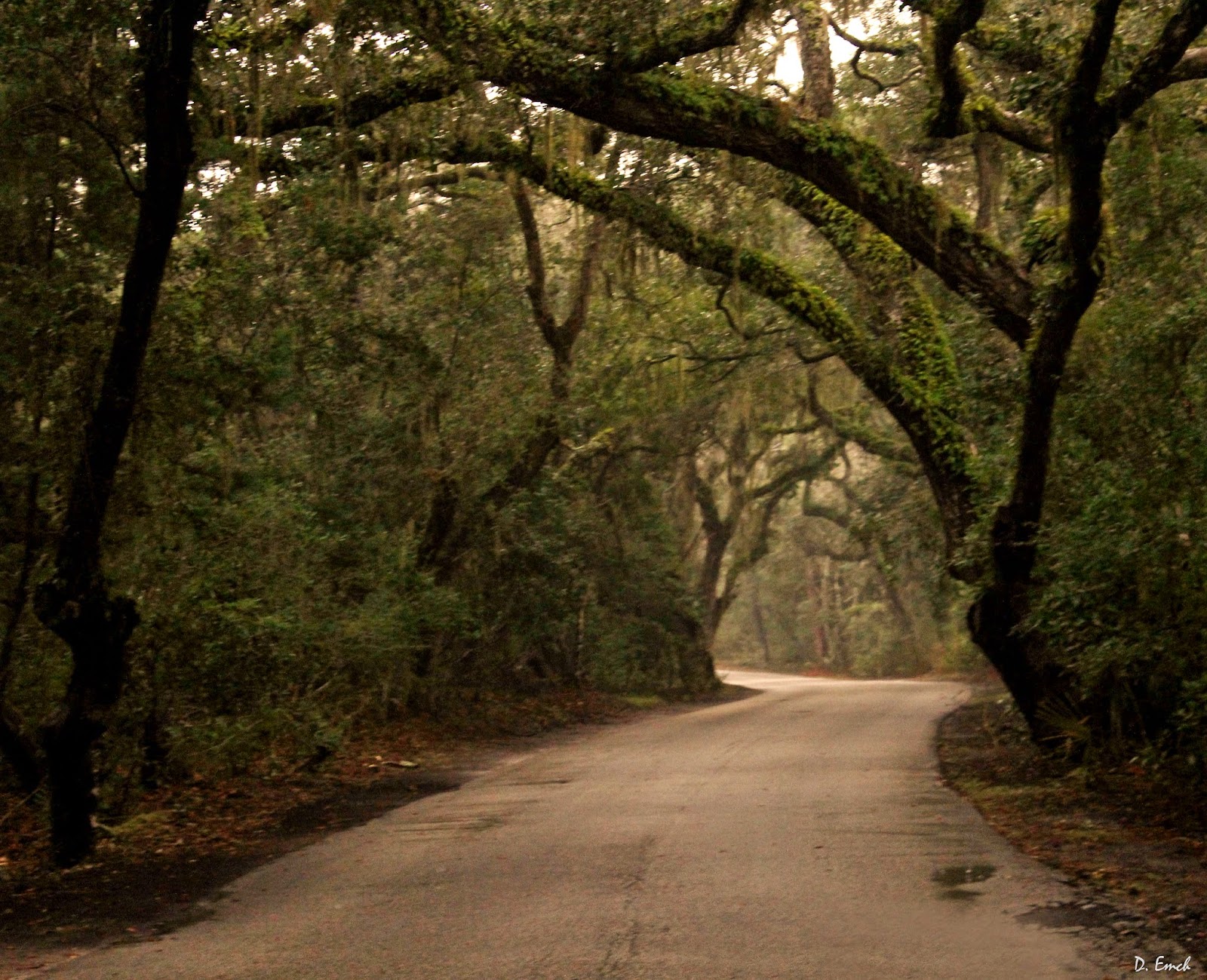
Amelia Island has a fascinating background, and when you look at it you know that only a small percentage of the tales that could be told have been recorded.
The island boasts that it has had eight flags fly over it - and if the notion is about who has controlled the island the number is undoubtedly higher than that.
We start at the Amelia Island Museum of History, a good place to visit if you are on the island. Bobbie Fost, an energetic New Jersey retiree, served as docent today.

The guided tour lasts about an hour and a half, and this is a case where attending the tour is much better than trying to see the museum yourself. There are seating arrangements at various displays that you rotate through as the docent lectures on the background. I will do my best to relate what was told me accurately.
The longest term inhabitants of the island didn't have a flag, so they don't count in the total. These are the Timucuan Indians.

The Timucuans were a matri-lineal society, meaning that children settled where their mother was. When a male married, he had to move to the community his wife to be lived in. These were a peaceful bunch, and although no one knows how many years they were here prior to the arrival of Europeans, the number is in the thousands of years.
This society assisted the first Europeans in gaining a foothold here, and the Europeans did not intentionally kill them off as they did in so many areas. But, within a few generations of the Europeans arrival all of the Timucuans were dead - dead of diseases such as small pox that they had not developed a genetic resistance to. There are no known descendants of this tribe.

It was the French who first arrived here in 1562. This flag was short lived - the Spanish came three years later and executed the 350 colonists.

The Spanish were fervent in their zeal to convert the "savages" to their brand of religion. And probably because there was no gold or silver here to exploit, the Spanish were not so driven to abuse the locals.
The Spanish were here until 1763 - a rule of almost two hundred years. There were various missions and forts built here, but archaeologically little remains of the Spanish influence.
In 1763 the English beat the Spanish in the 7 days war, and as part of the surrender Spain ceded Florida to England.

This English rule only lasts for 20 years, as the English took a drubbing from the colonists to the north that were forming the United States. In 1783 the English cede Florida back to the Spanish.

This time the Spanish don't kill everyone off - they give everyone 18 months to leave the island or to swear allegiance to Spain. The modern day city of Fernandina Beach is begun, although the downtown area is to be relocated in years to come.
This time era brings a lot of changes - the United States starts to find its stride as a republic. Slavery is a hotly contested issue, and the United States bans the importation of slaves in 1810.
Well, right across the river from Amelia Island is the United States, so Amelia Island became heavily involved in African slave smuggling. Supplementing the slave trade was rum running and piracy, and compounding the issue was the fact that while Spanish slaves could buy their freedom, English slaves were slaves for generations. Blacks who were free were re-enslaved under the English, and now under a second Spanish rule there is a lot of confusion as to who belongs to who.
Also under the Spanish, some whites were slaves and some were indentured servants. There were blacks in this area who owned land and had white slaves - the whole thing got terribly confusing.
Confusing this issue further, many Creek Indians fled here to avoid being exterminated by the colonists in the Carolina s. They bred with the blacks that were here, forming the beginning of the "Seminoles." This group never "fit" here, and both the English and the Americans abused them and passed laws to get rid of them.
In the early 1800's, the United States was getting tired of all of the smuggling and piracy going on at its southern border. So President James Madison ordered an invasion that was to look like a fake revolution. $ 250,000 was put up, and gunboats were sent in 1812 to control the island. The flag of the new territory was called "The Patriot's Flag."

The few Spanish soldiers that were here fled south to St. Augustine, and eventually United States admitted they were behind it but told the Spanish that they were "holding the area in trust" for them.
But in 1813 the Spanish came back and forced the United States off of the island. Back up went the Spanish flag. This lasted until 1817 when an Irishman took the island over. This set up a particularly difficult period of time for the local slaves, as can be seen in the history of nearby Fort George Island.

A fellow named Gregor McGregor, a soldier of fortune, took the island over with only 55 soldiers by faking the locals into thinking there were many more. The Spanish soldiers again retreated to St. Augustine. A year later, the Spanish force McGregor back off the island, but the USA has sent in new forces in disguise. The Spanish are not successful in driving them off of the island.
The mercenaries from the United States join forces with a French pirate named Aury, who for some reason claims the territory for Mexico.

Before long, the United States Navy returns and drives out the pirates, and now president James Monroe claims he is "holding the island in trust" for Spain.
From 1822 to 1845 is a territory of the United States, and in 1845 it is granted full statehood. Now the 27 star flag of the United States flies.

In January of 1861, Florida leaves the United States to join the Confederacy. Thus another flag - and although the confederate battle flag is usually shown, this is the flag that would have flown here.

Again short lived, Union forces arrived here and took Amelia Island without a fight in March of 1862.

By this time the flag was the 34 star flag. So, depending on how you count flags, there are eight. Or Ten. or Twelve . . . I am sure the pirate's skull and cross-bones flew here a few times, and the original Indians never had a flag.
Amazingly, the only real death toll on the island was from disease and those French slaughtered by the Spanish back in the 1500's. It seems everyone else just split when it was time to go.
There are a lot of exhibits at the museum - I have just chosen a few that I have not shown at various museums before.
Here is Edison's original record player.

The first ones didn't play discs, they played drums that had the grooves cut in them to produce the sound.
Now here is an ancient contraption.

Shoot, many of us remember when Polaroids first hit the market. That wasn't that long ago, was it?
One of my favorites though was the Pez collection. I didn't know there were so many Pez dispensers.


KISS?

The Simpson's?

And Chick Filet? I am told there are over 550 kinds with thousands of variations. I guess this is a microcosm of society that will be a sort of "who's who" in future museums.

There is another State Park on the South end of the island to compliment Fort Clinch. This is the first public place I have seen that you can drive vehicles on the beach.

Unique to Amelia Island are thistles the size of bushel baskets.

Down on this end of the island is an old bridge about a mile long that is all fishing pier today.

It is a long walk out, and people come from far away to fish here, but there is plenty of pier. I am not sure why they put a limit on the number of poles.

This is Jonathon West who comes up once a month or so from Jacksonville. He is one of the ones with his act together.

Chairs, fishing gear, coolers - all on a handy wagon. He even brings food in case the fishing isn't good and he needs alternative dinner plans.

Even the police have neat vehicles here. This looks like something out of one of those Mad Max movies.
And today's parting shot, taken from the South end of the Island:

EMAIL me if you like, DONATE if you can, Read Today's Meditation if you have time, but whatever you do be sure to Have an Awesome Thursday !!
David