Showing posts with label ME Bath. Show all posts

Sunday, August 30, 2015

Maine: Bath and Boothbay tug boat building


     Welcome back to Bath, Maine.   Before we finish up here, I want to acknowledge a great photographer who spends much time shooting this part of the country - Fred LeBlanc.  
(Above is one of his shots.)


     Fred was instrumental in getting us out on the Heritage a few weeks back.  As you can see he is also a master of the finish editing of photos.  He sells prints and teaches workshops - you can connect with Fred by Clicking Here.

     We wrap up in Bath back at the Maine Maritime Museum.


.     Today we meet senior curator, Nathan Lipfert.


     Nathan's parents took him to numerous museums as a child, and he dreamed of "running away to the sea."  In the late 1960's he did some volunteer work here. 

     In 1970 he got sweet on a girl, but one of her requirements was that he get a job.  The museum was hiring, so he took a job and as of 45 years later, he hasn't left.  That was about the time the museum was acquiring this current location, and as we saw in the Article on Ship Building they have accomplished a lot.

     Nathan plans to retire next year, and intends to write several books on ship building and the tools that have been used to build ships.  He says that there is a new energy that comes when we make a change, and he thinks the new energy represented by the younger folks that are coming into their own in the organization will be good for it.

     It is really a remarkable place Nathan and all these other folks have built.  Experts from many fields of marine study are eager to come here to speak, and inside the conference center they give lectures to standing-room only crowds.

     To touch on just a couple of the displays I thought were interesting - here is a hand built model of what this shipyard looked like back in the day.  Notice that included in the model are several buildings we toured the other day.


     This area exported a lot of ice to southern climates.  It was packed in sawdust - a commodity that was readily available here.  Special ponds were formed to "farm" the ice, which was cut into manageable sized blocks for shipping.  Here is an "ice cutter" used to carve the pieces out of the ponds.


     There is also a large section that touches on the boat building techniques of more recent generations.  


     During WW II it was mostly women building these ships, as those of you familiar with the "Rosie the Riveter" campaign will recall.  There is a large display of items that were shipped here from around the world, scrimshaw and ivory carvings as well as many scale models of boats from the 1600's up to present.  Another interesting item was a "cotton packer."


     Cotton is a light product and it was in the merchant's interest to pack as much into the ship as possible.  There are accounts of them packing cotton bales so tightly that the pressure popped the deck planking loose.  

     Nathan gave us a referral to a local company in nearby Boothbay that builds modern boats.


     Boothbay is a quiet town on sheltered waters that started as a fishing camp back in the 1620's.


      Here we find the tugboat manufacturing firm of Washburn and Doughty.


         This firm was founded by Bruce Washburn and Bruce Doughty, two Bath Iron Works employees who struck out on their own in 1994.  They built a large fishing vessel on the side while still employed at the iron works and used the money from that contract to launch out on their own.


     As is usual in Maine, the property still has the old shipyard owner's house on the hill overlooking the yard.  Here it is used as the company's offices.


     Katie Maddox, daughter of Bruce Doughty showed us around the facility.  


  Here we are speaking with structural supervisor Ken Doak who is explaining how we get from big sheet of metal to a reliable work boat that can be trusted to guide the big freighters into port. 
     

     In one area large sheets of metal are worked into forms and the hull takes shape one piece at a time. 


     The large yellow contraptions are electromagnets on a frame that allows hoists to move the sheets around the shop.


     This is about making the sheets of metal conform to the plans - lots of heating, shaping and welding.


     Separately the interior rooms and the pilot house are formed.  Then these are brought together and the exterior of the boat takes shape.


     Right now they are filling orders for several 100 foot tugs - boats that are a lot more massive than they appear when they are working alongside the cargo ships.  Here the client's name is formed out of raised metal letters.


     Another time consuming phase is grinding the welds smooth.  


     The boats are launched before the interiors are outfitted - but they have to be painted first.  When a boat is ready to paint the crews work over a weekend to keep dust and debris at a minimum.

     Two EMD 12 cylinder 3,000 horsepower engines are installed.  EMD was originally a division of General Motors, but now stands on its own as Electro-Motive Diesel Company.  
     

     These motors were designed for locomotives, and there are 16 cylinder and 20 cylinder models even larger than this.  

     The firm builds these vessels from keel to radar antenna.  Here is the pilot-house of one that is nearly ready for delivery to the client.


     Most of these 100 footers are set up to sleep six or seven people, with many conveniences such as a modern galley, dining area and laundry appliances.  So there is lots of wiring, plumbing, cabinets and finish carpentry.


     The dense rubber bumpers are added to minimize damage when pushing and you have a completed boat.  The company is currently manufacturing about four of these a year.


     Right next to Washburn & Doughty is Hodgdon Yachts.


     The folks at Hodgdon Yachts were friendly, but said they have a confidentiality agreement with their current client so they couldn't show us around.  


      Its a shame too - this is the oldest family of boat builders in the United States.  They have been launching boats from this location since 1816 - 200 years of adaptability and resilience.  In the 1970's Timothy Hodgdon, representing the fifth generation, took over the business and embraced the new carbon-fibre construction.  On their website are numerous pictures and more details.  Although I don't know anything about what they are building at the moment, it's big enough that it looks like the building is giving birth to it.

     We meet Jim Leckey at the marina.


     Jim spends his summers on the Aeolus, pictured below.


     Aeolus was the Greek god of the winds.  Jim has been sailing for decades.  45 years ago Jim was heading to Alaska, but decided to stop in this area for a weekend to visit a college friend.  The friend threw a party for him, and at the party he met a girl . .   and here he is.  He studied architecture and has dabbled in many things since.  He and his wife have been together long enough that they both enjoy the summer break they take from each other.

     If you are from Charleston SC you are probably acquainted with Zan Smith's Sculptures.  Here is a piece in Boothbay reminiscent of his work.


     And just up the street is a  . . . 


     Soccer Lobster? 

    Back at the Maine Maritime Museum we meet Katie Meyers.


     Katie was an English major who spent ten years as an editor for a media company before coming here.  She handles marketing and communications for the museum, and today she has a special treat for visitors to the museum.


     This is the Maine Responder, a 208 foot vessel that specializes in cleaning up large oil spills.  Tomorrow we will take a look at the boat and visit their facilities in nearby Portland Maine.

     Speaking of Portland, it will be our last major stop in Maine.  I am told if you spend more than 90 days in Maine you become a "Mainiac."  


     We are pushing that deadline hard - we arrived here the first of June.  That brings us to today's "Faces in the Crowd" - a lady and her son who were on the museum's Lighthouse Lover's Boat Tour.


     And today's parting shot, spotted at a t-shirt shop in Bath:


Click Here if you can contribute to this effort, and you can email me at captureamerica1@gmail.com

Make it a great day !!
David

Thursday, August 27, 2015

Maine: City of Bath


     After Exploring the local waters and spending a day Learning About Wooden Ship Building, we are in Bath to explore the town a bit.


     This city was originally named "Long Reach" in reference to the straight 3 mile stretch of deep and protected river waters.  According to the local historical society, there is evidence that the Vikings visited here in the 1100's.  Europeans started trying to settle the area in the mid 1600's but didn't really get a foothold until the early 1700's.  It was later named Georgetown and then finally incorporated as Bath in 1781.


     Aside from the local museum, the area has a long history of philanthropy by locals.  There is a beautiful free library and town hall, both built and donated to the city by previous residents. 


    Many of the local ship building and commercial shipping people made good, and made it clear that they cared about where they live.  


      Although some of the areas are literally carved out of granite, for the most part there is a gentle slope alongside the river that was ideal for ship building and deep water access.


     In northern Maine we saw tides running almost thirty feet - and while the tides are not that severe here they still large enough that seven miles up the river sees a six to eight foot differential.  Early settlers saw this as a great power source, and as shown below tidal driven saw mills were constructed across the river.


     Unlike the ship builders to the north that so mistrusted steam power that they ultimately went out of business, the builders in Bath embraced the technology.  Here is an early steam ship that still had sails.


     I saw a reference in a book to these ships as "Hermaphrodites," but in the museum a "hermaphrodite" ship was shown as a schooner that had 1 mast set up as a square rigger.  Which ever it is, I get a kick out of the name.


     The major wars have been a boon to this area.  Before World War I there were several major shipyards here, ultimately shrinking to a single one, Bath Iron Works.  


     At its peak production during WW II, this area was launching a new naval vessel every 17 days.  That is an amazing amount of material and work, and much of it was done by women as the majority of the men were off to war.  

     A lot has been accomplished in this town over the years, and the love the residents have had for the community isn't just something they have paid lip service to.  You can walk through the downtown areas and see that careful planning and thoughtful improvements have been made with the well being of the residents in mind.  One decision of vital importance that was very controversial at the time was when Bath refused to jump on the Urban Renewal bandwagon a few decades ago.  In a rush to "modernize" cities many historic buildings were torn down and much of the character was lost in many cities nationwide.  This area had the wisdom to resist it, and the result is a downtown that still has structures representing numerous eras of architecture.

     We saw a little bit of the great legacy the previous generation left Bath in the form of a museum, and as that generation passes on a new one is picking up the torch.  Meet Andrew Deci, Director of Planning and Development for the city since 2010.


     Andrew was raised and educated in Virginia, and had an opportunity to work as planning director in a city there.  But he came to Bath because of the love the people have for the area.  Andrew was wise enough to realize that if he wanted to do more than just draw a paycheck in a job like this, community participation is crucial.

     I can say that I have witnessed this attitude all through Maine, and I love the people for it.  It shows in all kinds of little things.  Like the banks.  Most every town has its own bank - people don't patronize the big Wall Street firms.  When you ask people why they tell you that if you want to have a thriving middle class you have to support them.  If you want to have money recirculate through the community, you have to spend it with locally owned businesses.  So you see a lot fewer of the big box stores and the chains here than you do other places in the country.


     And, by the way this is a heat wave in Maine.  The other day it hit 90 - much hotter than folks are used to here.      

     One of the many tools Andrew is using is a template for historically minded community revitalization called "Main Street USA." 


     This is an organization made up of local business owners, concerned citizens and local government officials.  The goal of the group is to implement improvements that are conducive to local residents, local businesses and visitors.  I attended one of their meetings, and space by space, block by block and area by area the group makes a big difference.


     Signage is always a big deal in Maine.  Billboards are banned, and you rarely see a sign for a business bigger than 4 feet by 8 feet.  Although this is a hurdle in some ways, it makes Maine much more appealing to the eye.  

      Locals are continually giving small plots of land for parks and suggesting improvements to existing areas.  Also attending the meeting was the city's arborist, ready with suggestions and insights as to how the city's green areas can be improved.

     But as much as anything the existence of this committee helps with the exchange of ideas throughout the community.  People have an avenue to government and feel that they can contribute to the well-being and the improvement of their city.  One resident recently paid to revamp an old YMCA into a community theater - on his own dime.  Another, while I was there, had a piece of property that he had planned to use for something else but decided to turn it in a small park and make it available for public use.  And I heard of numerous projects that have been completed with equal contributions from merchants, citizens and the city.  One of the topics at the meeting was a gala they are planning for next year that will help raise funds for further improvements to the downtown area.

    It is worth noting that the 3 years ago the town won the Great American Main Street Award.  The video they produced for that endeavor can be accessed by Clicking Here.  The video gives a better perspective of the area than I am able to get with still shots.  Another neat thing they have started is an annual Random Acts of Kindness Day.

     The town has slowly been building a string of parks and a board-walk along the river.  A developer recently purchased this property on the end of town and they were able to negotiate an extension of the current boardwalk to run along this section.


     Another old warehouse is coming available, and Andrew is actively looking for someone who can turn it into a micro-brewery or some other socially oriented business along the river.


     This downtown area that we are talking about all lies on one side of the bridge of the main route through town - US 1.  In the picture below it is on the far side of the bridge.


     To the left is the sprawling complex that makes up Bath Iron Works.  


     This shipyard was started in 1884 by a local civil war veteran.  One Thomas Hyde started out purchasing a small shop that made miscellaneous iron parts for boats, and then through expansions and acquisitions slowly developed it into a ship manufacturing company.  Naval vessels built here during the wars earned the respect of sailors who coined a phrase "Bath built is best built."

     Up until 1981, the company built numerous types of commercial vessels along with the military ships.  However, in the last 35 years the shipyard has only had one client - the United States Navy.  

     Prior to 2001 the company built the ships on the natural slope of land and launched them in the time honored fashion of letting them slide down ramps into the water.  (This is the location of John Wayne's Famous Ship Christening.)   


     In 2001 they built a large concrete area with rails that move sections of the ship into a movable dry dock.  (shown below)  


      The dry dock is then towed out into the river and sunk, allowing the vessel to float free.  Oddly, in a city where many of the best iron workers in the world reside, the company had the dry dock manufactured in China and barged in.  

     The company currently makes these "Zumwalt Class" stealth destroyers.  Originally the navy ordered 32, but as costs of the new technology escalated they cut the order several times, clear down to 7 ships.  A congressional memo a few years back claimed that these ships are now costing us 6 Billion dollars each.  Billion.


     As I talked to retired Bath Iron Workers and other locals, I heard about a long history of this company's involvement in the community.  But in 1995 ownership shifted from locals to General Dynamics.


     Over the last few decades General Dynamics has become a large consortium as it has gobbled up smaller companies that specialize in military equipment.  As this transition has taken place, the company's demands upon the community have risen and their contributions fallen.  I am told that of over 5,000 employees only about 500 actually live here now.  More than one person talked about the constant downward pressure on compensation.  The company's website boasts a profit of about 2.5 Billion in 2014 with a total of just under 100,000 employees.  The math says the company profits about $30,000 an employee per year - pretty hefty when you consider execs making over 100 million a year.  I would be interested to know if the company makes more per employee than the workers themselves do.

     The company has alternately "played hardball" and plead poverty in recent years, and I have to wonder how far they can push.  The geography of Maine is beautiful, but the resourcefulness and resilience of the people is even more impressive.  The people here will be fine with or without General Dynamics.  ( I want to make clear that none of the locals talked bad about the company - these are my own observations based on what I heard and read.)    

    This is the nicest piece of commercial land I have seen in Maine.  Given its proximity to downtown I can think of many things that could be situated here that would better serve the city.  Perhaps they would be well served to look at Wilmington North Carolina where we saw the city reinventing itself and its riverfront.  There are all kinds of talented shipbuilding folks still in this area - part of the land could be a very successful business incubator.  Or maybe the recent trend of corporations loathing the notion of social responsibility and community cooperation will reverse.  It will be interesting to see what happens over the next few years.

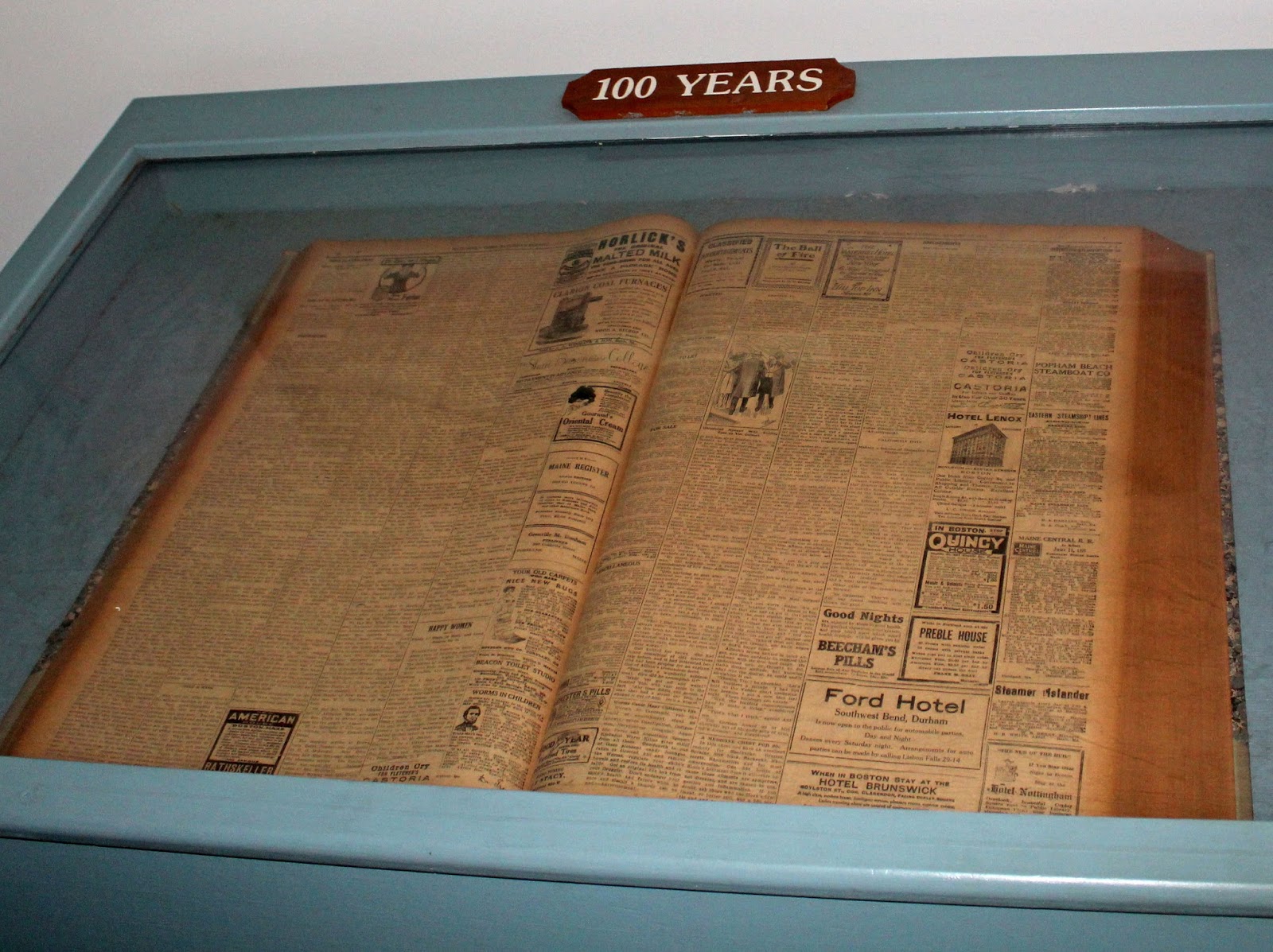
     Back at City Hall Andrew has a few neat things to share.  There are two display cases in the entryway that contain old town newspapers.


     One of them always has "today's news" from 50 years ago displayed and the other the day's news from 100 years ago.  Andrew says it is weird how often he will be dealing with an issue, glance at these papers and see that the townspeople were dealing with the exact same issue all those years ago.

     Back in 1889 a Bath built ship wrecked just offshore the Japanese city of Tsugaru.  The Japanese cared for the sailors, and since that time a relationship has grown between the cities.


     In 1993 the cities signed a declaration that they would be "sister cities," and since that date a student and cultural exchange program has been set up.


     The town hall's cupola holds an old bell - one made by Paul Revere's shop and with a serial number that matches the time period that Paul was involved in the work himself.  

     Another project being undertaken by locals is the construction of a duplicate of what is most likely the first ocean going vessel built in North America.


     In 1607 there was a colony known as the "Popham Community" established just outside Bath at at the mouth of the river.  They were ill equipped to survive in the harsh conditions here and had no way back to England.  (It is interesting to note that this colony preceded the "Plymouth Rock" colony by over a decade.)

     But a shipwright was living among them, and they took it upon themselves to build a ship that would take them back to England.  Locals are currently building a duplicate of that ship to serve as a "floating classroom" on the science of ship building.


     There is tremendous community interest and support for the project - just another way that the area is preserving its heritage.


     On the modern art scene, here is a sculpture in the front of a local tire store.  Locals call it "the creature."


     Which brings us to today's "Faces in the Crowd" - a rosy cheeked lad spotted at a local restaurant.


     And today's parting shot(s) come from the permit section of Bath's town hall.  They have the big rack of pre-printed forms for use when applying for various permits.


     There amongst heating permits, blasting permits and the like is an unusual form.


     I can just hear old Bubba saying: "Mildred, I am heading out to get the blasting permit for that daggum boulder, a heating permit for the barn and while I am there I am going to demand a few answers about those pesky head lice."

Click Here if you can contribute to this effort, and you can email me at captureamerica1@gmail.com

Make it a great day !!
David