Showing posts with label GA Midway. Show all posts

Thursday, December 11, 2014

Midway GA to Darien GA


     I did a lot of running back and forth to find little shrimp boat docks today, so the photos are not in any particular geographical order.  I did find a number of beautiful spots on the water along the Georgia coast.


     We are separated by about five miles of tidal marsh from the barrier islands, and I have not had any luck yet getting out onto Georgia's Islands.  Some of them require funds for a ferry trip and golf cart rental, others are private and government nature preserves.  Hopefully some doors will open.  But there still is a lot of beauty along the short of the tidal estuaries.  Today we are looking at shrimp boats - and there are more concentrated in this section that we have seen combined along the South Carolina coast.  Some of that was because of the seasons, but this area seems to have hung in there a little better in the shrimping industry.


     I am always curious about how people name their boats.  It seems about two thirds use a female's name or some feminine derivative, and of the remaining third a large percentage is either pirate or blockade runner inspired.


    You can look at a shrimp boat from a hundred yards and tell a lot about the owner and crew of the boat.  There aren't many derelicts in this area - is seems the majority run a tight ship.


     Like old cemeteries, shrimp boats have a wide variety of materials, textures and colors that come together in one place.


     Some boats you see the rust everywhere, the ropes and cables tangled, electrical wires spliced and lying about on the deck - some of the boats I would trust to go out on.  The same is true of the little marinas.  This spot below is a span of about ten feet, and I declined to try it with my camera gear in hand.


     And here is a boat that the owner let go just a bit too far . . - lying right beside the dock, occupying valuable real estate.
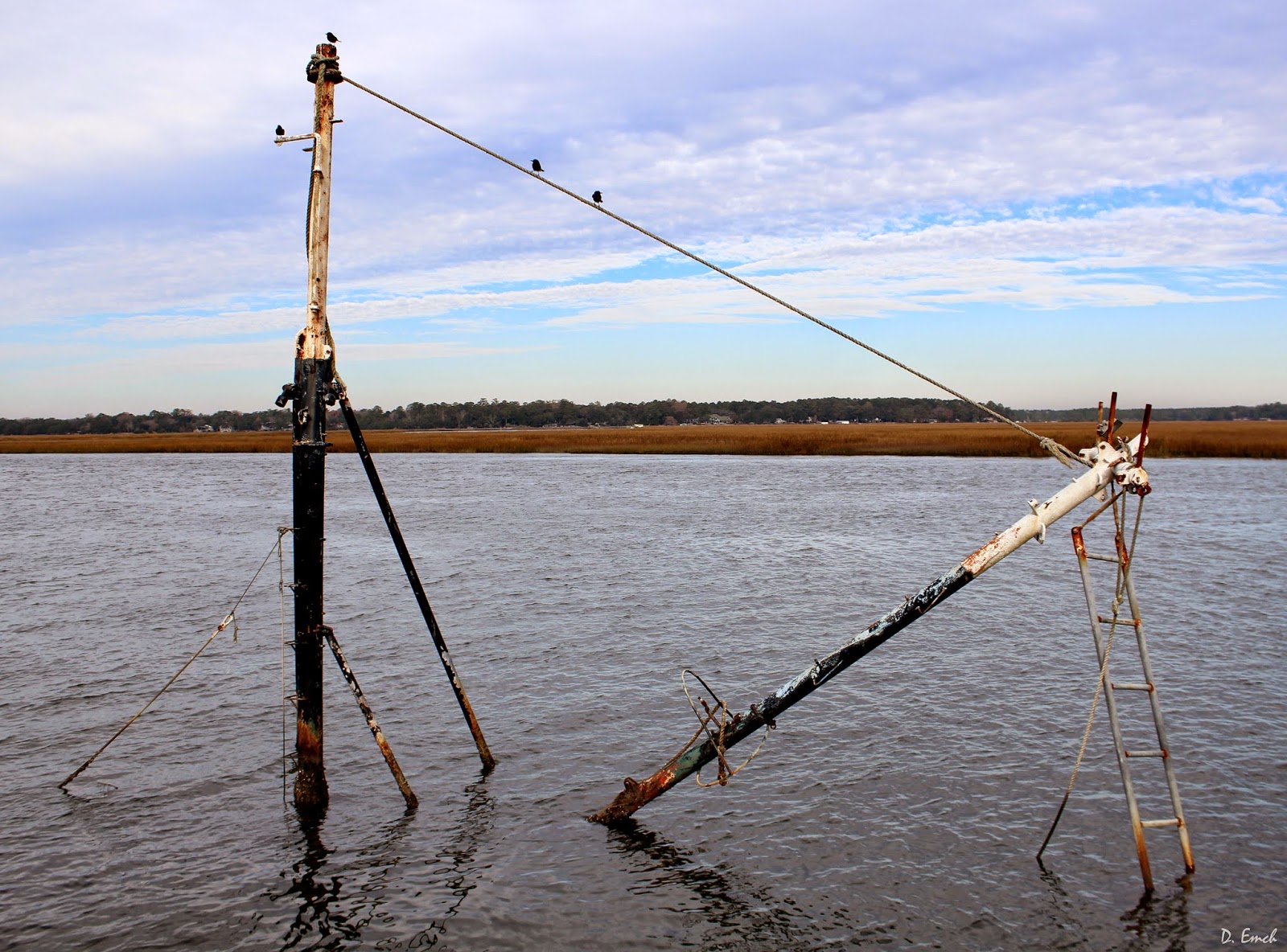

     And then there are always those barges and boats lying around that clearly have outlived their use, but for some reason people keep them hanging around.


      But again, in this area the marinas are in pretty good shape.  Some of them appear quite old, but you can clearly see they are dutifully maintained.


     Here is the Miss Bernadette, operated by David Chisolm, who is pictured below.  David was a heavy equipment operator in the army up until the early 1980's.  He returned and has been operating shrimp boats since - for over thirty years now.  

     This boat was his uncle's, and when it sold he agreed to come on with the new owner for a year, as the buyer didn't know a thing about boats.  David longs to get back to working the Texas coast.  He says deck hands in Texas make as much or more than captains and owners on the Atlantic.  He says the only draw-back is that you can only shrimp at night in that area, due to the clarity of the water.

David Chisolm

     David is very comfortable in his own skin and has a quick wit.  He reads the book of Psalms out of the bible with regularity, and says he works hard to stay in God's will.  After spending about an hour with him, I believe it.

    Seagulls and Pelicans that hang out around marinas are about like alcoholics that hang around the pubs so long they turn into "bar-flies."  This seagull below is so over-fed that he despises to have to fly.  You can walk right up to him - I had the camera about three feet away in this shot.  So much for a sea-food diet.


     This morning, one fellow was throwing out some fish remains and yelled - "look there !!"  I spun around and shot this - out of focus, with the wrong settings and the wrong lens.  But here is a bald eagle snatching a meal from the marina.


     One thing some of the marinas have are big ramps with winches so that you can get a big boat out of the water to work on.  All manner of algae, seaweed and barnicles will grow on the bottom of a boat, creating serious drag in the water.  This is very hard on the boats handling and fuel consumption increases dramatically.  Here is one pulled up on the ramp to clean and re-paint her bottom.


     The paint that is used has a very high copper content in order to kill off as much of the damaging aquatic life as possible before it can affix itself.  Here is a fellow grinding off the old paint.  It is terribly hard on the lungs - perhaps his beard is acting as his respirator. 


    Oops, guess he didn't like that comment.


     I would tell you his name and a bit about him, but all I could find out is that everyone knows him as "hippie."  


     A turn down a random road running toward the short brought a nice surprise.  There were tabby ruins right out on the banks of the river.  You may remember the Tabby Ruins on Dataw Island.  These are usually the oldest structures in these areas made from a base of oyster shells.


     A little digging revealed that this was a rum distillery and sugar mill in the early 1800's.  In 1824 it was heavily damaged by a hurricane and has been left in decay since.

     There was even an old water-well close by the structures.


     One of the fun things about the coast is the variety of structures you see - often right next door to each other.  There are a number of mansions build amongst the life oaks along the river-banks.


     And then there are those that have been abandoned - some so long abandoned that trees now grow out the windows.


    And then there are those that look so Southern . . like they could easily be a movie set.


     Which brings us to our parting shot.  Now this is a new one on me - but it appears to be an effective way to fix a leaky roof on a mobile home.  Just build another roof over top of the whole structure.  Problem solved, and they didn't even have to use and duct tape . .


EMAIL me if you like, DONATE if you can, Read Today's Meditation if you have time, but whatever you do be sure to . .

Have an awesome Friday !!
David


Midway Georgia church, museum and fort

Midway; GA

     Welcome to Midway Georgia.  And yes, that is a real photograph I took this morning.  I fell in love with the little church here - it is so accessible to photograph and has so much personality.  So you will have to indulge me with several shots of it today.


     This town's history is primarily of the pre-Colonial era, and so the graveyard across the street from the church has many tombstones with dates in the 1700's.  In 1695 a group of Puritans from Massachusetts moved to Dorchester County South Carolina - close to Charleston.  In 1752 they moved again - this time to this area of coastal Georgia where they prospered as plantation owners.


     The first church service on this site was in January of 1757, but the British burned it during the Revolutionary War.  This structure was built in 1792.  Subsequent to that four satellite churches were built in surrounding towns, three of which still stand.


     During the Civil War Union General Judson Kilpatrick occupied this area, and ordered that the church be used as a slaughter house.  The congregation never used the church again after that.


     Minister's salaries were paid by renting out pew spaces to various families.  Since many of the plantations were far flung, a number or "little houses" were built on the surrounding grounds so that families had a place to spend the night.  They often would leave their plantations on Friday and spend both Friday and Saturday nights in their "little house," which usually were built complete with a fireplace for warmth and cooking.  


     The church, the cemetery and a museum next door have all been taken care of by donations and labor provided by the descendants of those original church members.  To this day they have a get-together here every spring.  A list of descendants of this original group reads like a who's who of American inventors, clergy, lawmakers, ambassadors and even presidents.


     The key to the original church - the circa 1750 one - still exists and is in a display case next door.  This is the original key from when this structure was built.


     Across the street is an adorable cemetery.  One thing about these old cemeteries in the South are these amazing live oak trees.  Look at how this one has used another tree as a prop and grown over the wall.  That wall is over six feet high - this is a massive tree.


     But you cannot count the tree rings on a live oak to get its age.  As this one shows, the center of the trees rot and end up hollow.

     As with every cemetery, there are some "stories."  This next one is fascinating.  It seems a certain fellow - a Mr. Williams - had a house servant who was a mulatto woman from New England named Chloe.  She was made a house servant, and his young wife and Chloe bickered frequently.  Finally he had to banish Chloe to the fields.  Shortly thereafter his wife took ill and died.  Chloe came back to work in the house, he remarried, and the exact same thing happened again.  He remarried a third time - and IT HAPPENED AGAIN.  He married for the fourth time, and it was happening again, but one night when he went to toast his wife Chloe ran up to the table and knocked the wine glass out of his hand yelling "That glass ain't for you."  She was found out - she had poisoned three wives in a row.  Mr. Williams is buried with all four wives beside him - seems the lad was a bit of a slow learner.


     Then there was this fellow below - a physician from Virginia named Dr. Abner Porter who was Midway's only known suicide back in those days.  Supposedly he was in love with two women, and could not decide between them.  So torn he became that he killed himself.

    The Puritans did not believe that a suicide deserved a Christian burial, so they buried him outside the wall of the cemetery under this oak tree.  Later, the graveyard was expanded and his crypt was now inside the walls.  Soon after, the roots of the oak began lifting the crypt - legend saying that the oak knows he does not belong there and is trying to expel him.


     In the north wall of the cemetery there is a crack in the wall.  When that section of the wall was being built, two of the workers (slaves built the wall) began quarreling and one killed the other with a brick.  He threw the corpse into the foundation of the wall and quickly built that section of wall over top of him.

     When he returned home that night, he told his master that the other slave had run off.  No sooner than the wall was completed than that section cracked and crumbled.  It was rebuilt, only to crumble again.  When they dug it out, they found the body and realized what had happened.  The wall was rebuilt again, and the crack reappeared - plainly visible to this day.


     Some of the tombstones look like they are being "swallowed up" by the trees.


     This is the first old cemetery I have seen that they actually put "unknown" on the crypt when they didn't know who it was.  


     And it seems every old cemetery has at least that "one guy" who just had to have his own walled and gated community within the confines of the cemetery.

     But here the keepers have even gone to the trouble to keep up some of the old wooden markers.  


     Across the street is an old gas station - which isn't that terribly remarkable but I loved what is on top of it.


      Its that GULF sign on the top of it.  I would love to see the guys from American Pickers try to get this sign for their collection.


     Also across the street is the museum - opened in 1959.


     Painstaking detail went into this house to make it as exact a replica of a 1700's wealthy plantation house as possible.


     I was not allowed to photograph inside the museum, but I can tell you it is well worth the visit.  There are many pieces far nicer than I have seen anywhere else that have been donated by the descendants of the original colonists.

     Curator Diane Kroell was a big help, even though she was just getting the Christmas tree delivered while I was there.
Diane Kroell

    And just down the street is the fort built in the 1700's to repel the British from advancing up the Medway River.


     The fort was an earth-works built on a little peninsula that juts out.


     It is a really nice quiet place, off of the beaten track.  A welcome center awaits you, and an old style cannon looks over the river.


     There are numerous spots for a quiet picnic overlooking a gorgeous area.


     Just up the street is a boat landing and pier where I met Matthew Ashby.  Matthew has been in the army for 12 years, serving in Afghanistan as a Chinook mechanic and crew member.  He has since been re-assigned and trained to fly drones.  Recently though he was given the indication he is going to be discharged - and he is enjoying himself meanwhile fishing.  


     The catch of the day?  This five inch grouper that he threw back.  It is hard to believe that if this fish lives, it will one day be the size of a Volkswagen.  You can't really see it in the picture, but the gills were a shimmering iridescent rainbow in the sun.


     Which brings us to our final photo(s).  This is the third "Smallest Church in America" we have seen.  I am going to have to get a tape measure and start checking them -  maybe we can get the dispute resolved on Jerry Springer at some future time.


EMAIL me if you like, DONATE if you can, Read Today's Meditation if you have time, but whatever you do be sure that you . .

Have an awesome Thursday !!
David