Showing posts with label GA - Atlanta area. Show all posts

Wednesday, May 28, 2014

5/27/14 Atlanta's Dr. David Cantor, Autism qEEG and Neuro-Feedback

Psychological Sciences Institute; Atlanta GA

     The motivation for the trip inland to Atlanta was two-fold.  I was told that the /Shepherd Institute was a world-class facility dealing with rehabilitation of brain and spinal cord injury, and as you could see from yesterday's post, I was not told wrong.

     The other group I came to see is Psychological Sciences Institute (PSI,) headed by Dr. David Cantor.  

Dr. David Cantor

     I was told that Dr. Cantor worked almost exclusively with child developmental issues, and that he had more than a few patients who suffered from autism that he had "cured."  Other Dr's spoke highly of him as a researcher, clinician and practitioner, and I was told he has become a leading expert on qEEG (high tech brain activity maps) and neuro-feedback.  Those things alone were more than enough to pique my interest enough to visit, and I was not disappointed.  I found more than I came for.

     I try to keep things in layman's terms, so the bottom line on David is that his doctoral thesis was on the qEEG, and along with a masters in psychology he has a masters degree in psycho-pharmacology, which is basically the study of the effects of drugs (medicine) on the mind and on behavior. 

     One thing strikes me about both the Shepherd Center and David.  They both look at the whole patient, and have staff and facilities designed to investigate and deal with all of the various aspects of a patients illness.  Working primarily with children, David deals with many autistic children.  "Autism is a spectrum illness" says David.  "Unlike many other illnesses which you either have or you do not have, it covers a wide range of symptoms and differing levels of severity."

     David has a large support staff that includes three psychologists, speech therapists, a nutritionist. physical therapist, neuro-feedback technicians, occupational therapists and others.  I struggled with the same issue as at Shepherd Center - I cannot take pictures in any setting that patients or their families are present.  But to give a feel of the place I did get a few.  But what I am able to do the least amount of justice to is the numerous efforts and outreaches David has initiated on behalf of children with developmental disabilities.

     Here are two large rooms geared toward physical assessment and rehabilitation.


     There are many things that separate David's clinic from others I have seen, but one of the most remarkable is how he deals with patients and insurance companies.  When a patient comes (no child is ever turned away here) he gathers the answers to specific questions and performs a series of tests.  Based upon the results of this interview and exam, he then tells the patient (or the patient's parents) exactly what tests he wants to order and why.  Sadly, 90% of patients do not have the level of insurance or the financial means to get the appropriate testing done.  

     Why so much testing?  David doesn't like treating symptoms - he likes correcting underlying conditions.  Often underlying chemical or enzyme imbalances cause negative symptoms and behaviors.   There are microbial imbalances, nutritional deficiencies, heavy metal poisoning, allergies, yeast sensitivities, impairment of bio-chemical pathways, inflammations - all manner of things can cause brain malfunction and thereby mimic or cause other conditions.  And unless these underlying symptoms are recognized and addressed the patient risks being sucked in to a never-ending morass of symptom management when a "cure" is available.  (David doesn't like to use the word "cure," but others use it when referring to his outcomes.)  Meanwhile, the older a child gets without the underlying issue being addressed the less likely they will be able to reverse the damage and lead a normal life.

     And this is serious stuff.  "Autism" case numbers are exploding to such a degree that members of congress have called hearings about it.  They recognize that if the underlying problems that are causing this increase are not realized and addressed society will not long be able to afford the burden of non-functional adults.  This problem is so severe that many are referring to it as a "pandemic" - which means a disease breaks out all over a country or the world.


     Here is a device that has brought some striking results called an Interactive Metronome. 

Interactive Metronome station 

      I cannot begin to do it justice in this short piece, but suffice it to say that it brings one's various body parts into sync with each other and with external stimuli.  This has shown to produce very positive results in the areas of attention and concentration, motor control and coordination, language processing and impulse control.

     And here is many of the patients favorite room - toys galore.


Neuro-feedback equipment

     And here is the neuro-feedback equipment.  I have published articles previously about the remarkable results that this has brought for epilepsy patients, stroke and traumatic brain injury victims, ADHD patients and migraine headache sufferers.  This is the treatment that has been showing strong results with Les that I posted about a month ago.

     This whole advance in the science of the mind has been made possible by the development of the new qEEG brain wave reading and analysis equipment.  Tens of thousands of "normal" brain maps of all ages and both sexes are compiled into a library.  One who is suffering with a neurological issue has a brain map done which is then compared to the library of "normal" maps.  When the differences in brain wave activity are noted, a plan of treatment is developed which "teases" the brain into proper function - without the use of drugs or invasive surgery.

     For example, here is a neuro-feedback brain map that shows areas of the brain that are deviating from healthy brain activity in red.  


     The bottom set of images is an "after" view - and the difference in brain functioning is easily seen.  This technique gives direct scientific feedback to the practitioner that actually quantifies the changes taking place with treatment.  This, combined with the changes in behavior noted by the patient and the patients family give a real good view on the brain's functioning.  And the results shown above are not some exceptional case.  This is the norm for patients whose brains have malfunctioning wave patterns that can be addressed.  And these "bad" wave patterns account for a surprisingly large number of neurological conditions that we have had zero lasting answers for in the past. 

     This is the core push of the journey and the fundraiser I have undertaken - and the reason I have done it is because this technique would be pushed under the carpet if certain institutions had their way.  Not only does the technique provide permanent, lasting results after a relatively few sessions, it does not generate the huge amounts of money that drugs and invasive surgery do.  And in many cases, the incredibly expensive drugs with their myriad of negative side effects are no longer needed by the patients.  And this, my friends, totals to many BILLIONS of dollars in this country.  And it is not just the BILLIONS in medications that fatten the pockets of those in the food chain, it is the many BILLIONS of people worldwide who suffer from these neurological issues that will be able to get relief and find their way back into functional lives.  

     So off my pulpit and back to David.  David's holistic (addressing the whole of a patients needs rather than one specialized area) is not unlike what we saw at the Shepherd Center - where the patient is treated rather than treatments dispensed.  David remarks about how patients that have gotten the neuro-feedback treatment long in the past don't come back like those treated with drugs.  Their change is permanent - the brain has been taught to heal itself and function properly.  But those that are taking drugs - the dosages are constantly being changed, tolerance builds up, side effects have to be addressed - they often become "chronic patients" with a never ending stream of issues.

     David has had numerous peer-reviewed papers published on various areas of study.  He works as a research partner at the university and governmental level.  There are numerous studies he has done - this following one dealing with ADHD and how neuro-feedback affects the symptoms of ADHD in patients that are not subjected to drug intervention.  Another area David has done remarkable work in is proving that qEEG brain maps can accurately predict intelligence BEFORE one takes an IQ test.  In other words, the images you see of brain maps can clearly display the quality of functioning going on inside our heads.  This is ground-breaking stuff.


     And this next set of brain maps shows a rather disturbing fact.  Without going into great detail, the brain maps below prove that the drugs given children to address symptoms of these conditions create permanent changes in their brain function.  The brains on the top got treatment after they had been given psych meds, the brains in the middle had never had psych meds, and the brain maps on the bottom show the residual difference.

Residual effects of prescription drugs on the brain

I am sure many of us suspected this, but having it shown clearly and measurably leaves little wiggle room.  If there are therapies that can be developed (such as neuro-feedback) that can address these neurological conditions without the use of powerful drugs and invasive surgery, the only ones who lose are those who profit from those drugs and surgeries.  Everyone else comes out ahead.  Again, this does not come as a big surprise to anyone that has dealt with health care institutions or professionals whose underlying motive is maximizing profits.  Does a medical establishment have the patients needs or their own pocket-book as the priority?  It has been nice to spend the last few days with folks whose sole motivation is the improvement of life for their fellows. 


     I have taken to video-taping interviews, and am glad I did with David.  He covers a broad range of facts and figures in a short amount of time - and he doesn't waste words.  I apologize to him if I have gotten anything wrong in this article - I have used this as an opportunity to bring some of you following this up to speed with what it is that I am trying to raise money for, and many of the things I stated in this article are my observations and opinions - not David's words.  

     I have now reached the six month mark on the road - and tomorrow I will spell out specifically how far this effort has come and how I envision it taking shape from here.

     Today's parting shot is from the trip back to South Carolina, taken in August GA.  On my trip through I showed how the railroad tracks run down the middle of one of the downtown streets.  Well, as I came back through a train had just passed.  Sorry for the grainy photo, but I had to quickly shoot over my shoulder and through the window.


 Have an awesome Wednesday !!
David


If you would like to contribute to this journey or to the foundation, just click Here.  If you have no idea what this is about, Click Here and Here.  Click Here to email me, and if you want to read today's meditation just click Here.  Thanks for your interest and support !!


Tuesday, May 27, 2014

5/26/14 Atlanta's Shepherd Center


     Welcome to Atlanta Georgia, a sprawling metropolis that is home to over 5 million folks.  This town also happens to be the birthplace and home of one of the most inspiring living testaments to the resilience of the human spirit to be found, The Shepherd Center.


      Founded in August of 1975, its creation was the result of one family's refusal to cave in to adversity, the Shepherd family.


James Shepherd Jr.

     In October of 1973, James Shepherd Jr. was celebrating his graduation from college with his friends in Brazil.  James lost control on a wave and was smashed on the ocean floor, severely damaging his spinal cord.  His friends performed CPR and got him to a local clinic, where doctors figured he was just going to be one more fatality of the brutal Brazilian surf.  


     His parents, Alana and James Shepherd Sr. arrived in Brazil the next day, and insisted that he be given antibiotics for the pneumonia he was developing.  Brazilian doctors were unwilling to work with him further than that, so they returned him to the States. 


     While he was recovering in Atlanta's Piedmont Hospital, two local men who had suffered spinal cord injuries of their own (Clark Harrison and Dave Webb) started to visit him and offer encouragement.  As a result of their friendship, the idea of creating a spinal cord injury treatment facility in Atlanta evolved.  They approached James' parents about helping them, and thus the nucleus of this thriving community was born.


     Angela from public relations, pictured above with one of the center's therapy dogs, served as my guide through the hospital.  Without proper releases I could not take any photographs that included patients or their families, and many of the rehabilitation areas teemed with patients working with staff and volunteers.  So although there are numerous areas that I could not get photos of, there were plenty enough that I did that I can share a feel for the place.  The hallways buzz with wheelchairs and patients moving about between various different departments.  Much thought has gone into the facility, and patient needs are addressed from start to finish.


     First, there is a large Intensive Care Unit that is equipped to handle patients from the onset of their injury.  The sooner rehabilitation begins, even if it is just a half hour or hour a day, the better the long term outcome for the patient.  The centers evolution has included the expansion into the area of traumatic brain injury and stroke recovery - in fact today the patients are about evenly split between brain and spinal cord injury.


     A large heated swimming pool with a wheel-chair ramp occupies a good portion of the first floor, complete with kayaks and many other implements designed to aid in rehab.


     A large gymnasium, again lined with various implements is used both for rehab and competitive events.  This is home to numerous teams representing a number of sports that previous clients and others who are disabled compete on.  A number of teams have competed in the Para-Olympics over the years.


    Numerous large rooms filled with equipment dot the complex - some adapted for children and others for adults.  Over the years many techniques for helping folks have evolved, and with that comes a lot of unique approaches.


     The facility also has a chapel, where it helps tend to the spiritual needs of the clients.  

Chaplain Ben Rose

     Chaplain Ben Rose has been here for ten years after working six years with Hospice.  "Injury cannot define you if you know who you are and who your God is" says Ben.   "I work with a patients existing spiritual tradition with the goal of integrating their experience with their beliefs."


     A separate annex addresses the needs of the families of the patients.  This wing houses families from outside the area for up to a month while their loved ones undergo treatment.  There are also numerous ample areas that allow the families and patients to interact or just relax.


     The "Hidden Garden" lies just outside, with planters arranged at varying heights that meet the patients at whatever level they are at.  A poignant statue in the garden acknowledges the struggle that patients face.


    And the wheelchairs, crutches, canes and various supports come in all shapes and sizes.  Some of these wheelchairs utilize a tube that the patient blows into to run and to navigate.  Other wheel chairs have their own unique touches.


     There are countless folks who are acknowledged on the walls of the hospital for their support in all forms.   But one seems to stand out a bit.  Billi and Bernie Marcus, owners of Home Depot gave the funds for one entire floor of the hospital.  


     This area is devoted to integrating clients back into their homes, schools and community - to helping meet their unforeseen needs as they make the transition back to home, school and work.  All manner of things are addressed from learning to drive again to job training and counseling.
   

     That founding spirit that was born with the two recovering men helping James Shepherd has not been lost.  Everywhere are testaments to patients that have learned to overcome their disability and become active, productive and content members of society.


     You see it everywhere in the hospital.  Patients are allowed to decorate a ceiling tile with any theme they wish before they graduate from the center, and hundreds of them adorn the ceilings of the various rehabilitation rooms.


     Dry erase boards adorn the walls that allow patients to leave encouraging messages to those that follow.


     There is even a wall that allows staff members to create a ceramic tile bearing a message of hope to those that come here.


     The hospital also spends a large amount of resources and capitol helping soldiers that have been injured in the line of duty. 

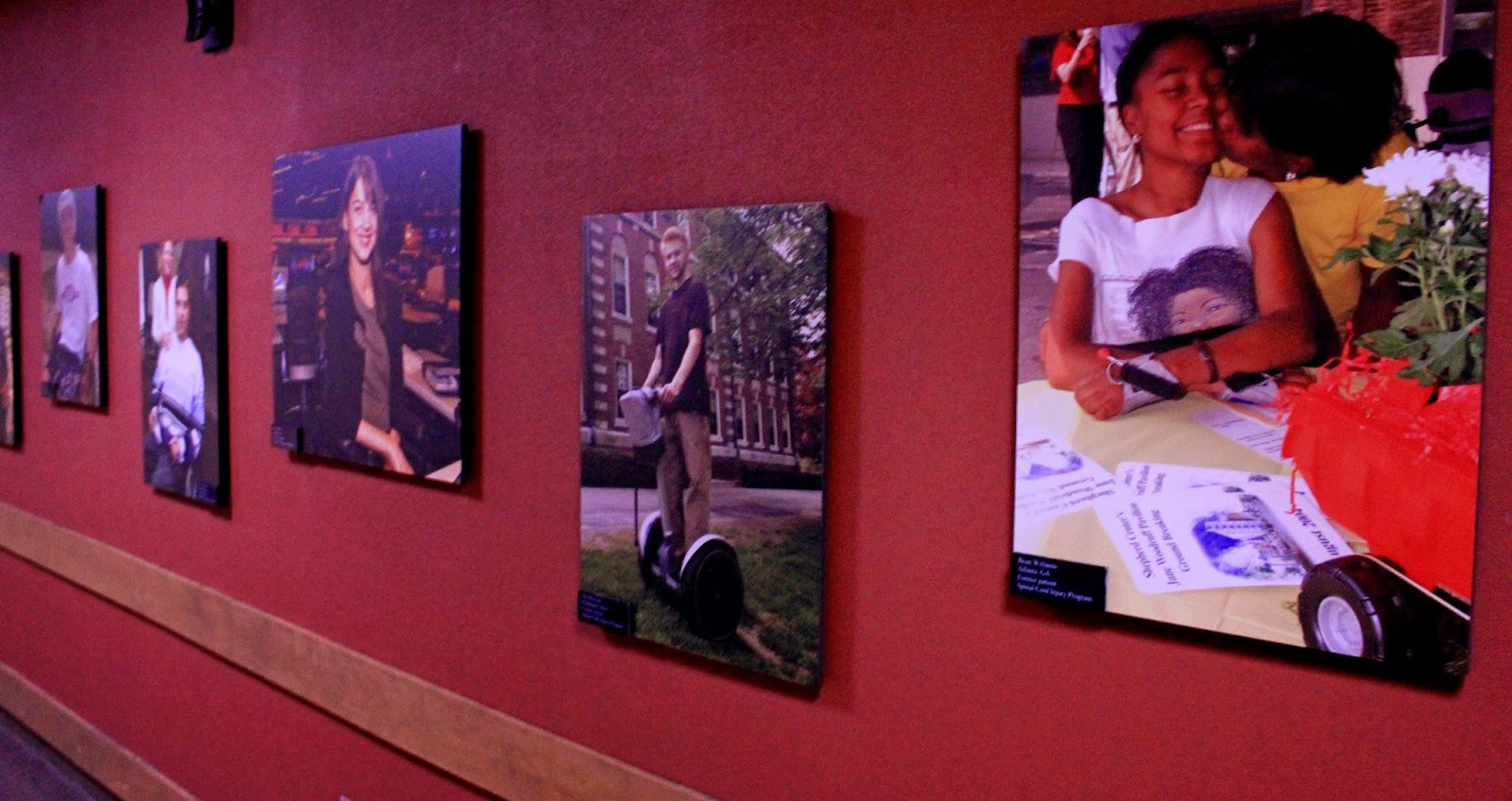
     The walls are covered with pictures and stories of those that have entered these walls devastated, but gained the skills to move on to meaningful lives.  


     Many of the alumni have gone on to remarkable accomplishments.  But the spirit of that original nucleus that started this place lives on.  There is an extensive peer support system that has been built up where both previous and present clients help those coming along behind them.  Numerous people remark how important it is to have others that one can talk to who know exactly what thoughts and feelings they are experiencing as a result of what they are going through.


     I wish I could show you images of the patients and their families.  Everywhere faces beam with smiles, laughter and kindness.  The hope that is found here is the lasting sort because it is coupled with viable solutions that address the needs of those that it serves.  This is no mere institution - it is a living legacy to the beauty of the love, resilience and determination that the human spirit is capable of.  

     Today's parting shot is found in a corridor that honors the many people whose support have made this place possible.  


     One thing you will find interwoven throughout all of the center is humor, and among the statues of bronze lining one wall this one stands out.


     It honors the current director of adolescent services, Dr. Herndon Murray.  Among many other things, his plaque credits him with treating 17,146 and 1/2 patients - supposedly his last patient "wasn't all there."  It is clear that he among many others here are loved and revered by tens of thousands of patients that this center has helped.

    Those that created and maintain this sanctuary have my utmost respect and deep admiration.  As the 40th anniversary of this place comes along in another 14 months, I hope they realize that they have touched and inspired many far beyond just the patients that they have helped.  This is a great model for a center that could be developed to help patients and their families that are struggling to overcome a wide variety of neurological problems.  Tomorrow we meet one of the top doctors in the nation that deals with child developmental issues such as autism and epilepsy.

All have a great Tuesday !!
David

If you would like to contribute to this journey or to the foundation, just click Here.  If you have no idea what this is about, Click Here and Here.  Click Here to email me, and if you want to read today's meditation just click Here.  Thanks for your interest and support !!

Thursday, May 22, 2014

5/22/14 Crawfordville GA


     Welcome to Crawfordville Georgia, the seat of Taliaferro County.  I have headed inland because I have interviews with two neurology groups in the next two days. so I am finding a story or two along the way.

     Today I exited the highway to get gas and saw a state park sign. I followed the signs and found myself in Crawfordville.  Here is downtown - the whole thing. 


     This side of the street is the bank, the post office and a few shops, most of which are closed.


     And this side of the street is the police station, city hall, flea market and fire station. 


     Rounding out downtown is the county building, built in the early 1900's for $15,000.  Crawfordville was home to a fellow by the name of Alexander Stevens.  Stevens was born in a log cabin not far from here in 1812, and graduated from the University of Georgia in 1832.

     He was elected to the United States Congress in 1843.  He voted against the succession of the Confederacy, but when he was out-voted he went along and ultimately became the vice-president of the Confederacy.  He was transported to Boston and held prisoner after the war, then returned to Georgia to serve 9 more years in congress.  He was ultimately elected governor of Georgia, and he died while holding this office.
   
Statue of Stevens


     Through the efforts of one of his nieces, much of his property was saved.  The house, along with slave quarters and out buildings still stand, and are now a Georgia State Historical Site.  


    The house and buildings are only open Friday through Sunday, but I found Raven, who is one of the park rangers, and she was kind enough to let me in and show me around.  Many of the contents of the house are original, some pieces dating back to the 1700's.

Raven


     This is an 1800's wheel-chair.  Stevens was given this one as a gift of gratitude by the city of Philadelphia.


     These little wooden weights were used by the women during the winter months to keep their wrists and fore-arms in shape for all the "fanning" they had to do in the summer months to keep cool.


     And here is his medicine chest - all of the items original and belonging to him.  His college room-mate was Crawford Long, who first used ether as anesthesia, so he might have been a little more opening to trying things than other folks.  Some of the bottles read: Oil of Tar, Bromide of Potash and Beef, Iron and Wine Tonic.  It seemed that the majority of the potions were primarily grain alcohol with some fancy sounding compound thrown in.  A wide range of cures was claimed.


     Adjacent to the house is the kitchen facility, stocked with implements from that era.


     Here is a neat thing - a Stereoscope.  Back in that time photographers would take two different pictures of the same scene, one slightly to the side of the other.  The two prints are on the same slide, and when viewed through this scope the pictures look 3 dimensional.

André

     The larger part of this complex is the 1200 acre Georgia State Park that also bears Steven's name.  André, pictured above is the head ranger at the park.  The park has 3 lakes and a large variety of camping areas, pavilions, sporting areas and walking trails.  Equestrian is a big part of the park - there are currently 14 miles of trails, and André just got a grant to add another 7 miles.  He and the other rangers will do the work themselves but are consulting with various equestrian groups on the layout details.


     There are a number of cabins around the lakes that are available for rent, although some of them are for group rentals only.  Next is the old fire-tower.


     This area was created in the 1930's as part of the CCC work program under F.D. Roosevelt.  Andre' has plans for a CCC museum to be built inside the old fire-tower.

Robert Kendrick

     Meet Robert Kendrick, local resident who has lived quite a life.  He was a Navy medic during the Korean war, he was a professional baseball player - catcher for the Cleveland Indians organization, and he then served a full career as an x-ray technician in the Air Force.  He was born and raised here, and after 40 years away he moved back.  He has been instrumental in converting two buildings in the downtown area into museums.  You see, Crawfordville has had quite a bit more history than would meet the eye.


     14 movies have been filmed in whole or in part in this town.  Coward of the County with Kenny Rogers, Paris Trout with Dennis Hopper, Carolina Skeletons with Lou Gosset Jr, Passion for Justice with Jayne Seymour, Sweet Home Alabama with Candace Bergen and Reese Witherspoon and Get Low with Bill Murray and Sissy Spacek are a few of the films.

     Kendrick has petitioned all of the locals for their old photos, copied them and created an exhibit of these and other memorabilia.  Adjacent to this museum, he has created another full of artifacts from eras gone by.


     Also included are photos of when the town's hotel and its movie theater burned years ago.  


     Since the fall of cotton and the small farmer, this county has fallen from 8,000 residents to 1,200 residents.  What houses are here are all very tidy and nicely kept, but there are many abandoned buildings about town.  Here is an elementary school.


    I liked that shot of the old fountain.  Many of the houses that are sitting vacant clearly were nice houses in their day.

     And here is the old train depot.  Sadly, much of the rural area between Savannah and Atlanta is like this - relics of thriving villages now falling into disrepair because of lack of industry and population.  But I met at least 20 people around town today, and you cannot beat the kindness and the charm of the folks in these small southern towns.  


     Today's parting shot is actually the shot I used with the meditation yesterday.  Here is the shot I used - did you notice anything unusual?


     Well, there was no fence between me and this fellow when I took that shot - I climbed the fence and was on his territory, counting on my ability to run around the large cactus plant if he came after me. 


     He looked like he might for a second, so I squared up to him and started speaking to him in a harsh tone of voice.  He seemed unsure, then finally decided I was just an annoyance and sauntered off.  If he had gotten a-hold of me, the outcome would not have been good.  Depending on whose side you were on, of course.

Happy Thursday !!
David


If you would like to contribute to this journey or to the foundation, just click Here.  If you have no idea what this is about, Click Here and Here.  Click Here to email me, and if you want to read today's meditation just click Here.  Thanks for your interest and support !!