

Today, our second and final day on Cumberland Island, we will take a look at a bit of the history. As with so many places, much of the history has long faded and there is nothing to photograph to give a representation of it. But we have a few photographs from the Ice House Museum.
The first era that we know of was the American Indian era. Of course there could have been numerous tribes live here over the millenia - we have no way of knowing. There are numerous shell mounds and pottery shards that have been found on the island, so there was a long history of activity on the island. Yesterday we saw a picture from the museum of an early french artists impression of the Indians. Much like neighboring Amelia Island, the Spanish had missions here back in the 1500's.
Not long after Georgia founder James Oglethorpe established Fort Frederica just north of here on St. Simons Island he pushed the remaining Spanish off of this stretch of islands and burned anything they had built. The English then started the Plantation Era on the island, growing cotton, indigo and rice along with a large variety of fruit orchards.
Here are a couple of old buildings that there were renderings of in the museum. The first one is of the original Dungeness Plantation house, built by the heirs of Nathaniel Greene of Revolutionary War fame.

Dungeness was the name of a town in England, and when the Carnegie's bought this same plot of land on the island and built the mansion whose ruins we saw yesterday, they opted to keep the same name for the property.
Not much is left of this era on the island, but there are rows of fireplaces and chimneys that were part of the slave cabins. It is estimated that in 1860, immediately prior to the Civil War, there were approximately 500 black slaves and 70 whites residing on the island.

The Union soldiers who came to the island were told to not burn anything, as Nathaniel Greene was well respected by Union General Sherman. Shortly after the Civil War the mansion burned though, and the Carnegie's acquired the property about twenty years later.
Following is a photo of an old hunt club that also burned to the ground. Robert E. Lee's father died and was buried on this island, but Robert had him dug up and reburied on the family plot up north.

Following is a photo of the fire that destroyed the Carnegie's main house, the ruins of which we saw yesterday.

Thomas Carnegie, brother of Andrew Carnegie was part of the early steel mill wealth from Pittsburgh Pennsylvania. He bought up a lot of land on the island in 1880 and 1881, then died a heavy drinker in 1886 at the age of 43.
Back on Jekyll Island I was told that the Carnegie's tried to join their club but were turned down for membership because their money was "too new." Whether or not that is true, the Carnegie's bought a huge chunk of this island, a neighbor to Jekyll right about the time that club was forming.
This is another photo of the ruins of the main mansion, showed burning above. It is believed that a disgruntled employee set fire to the place.

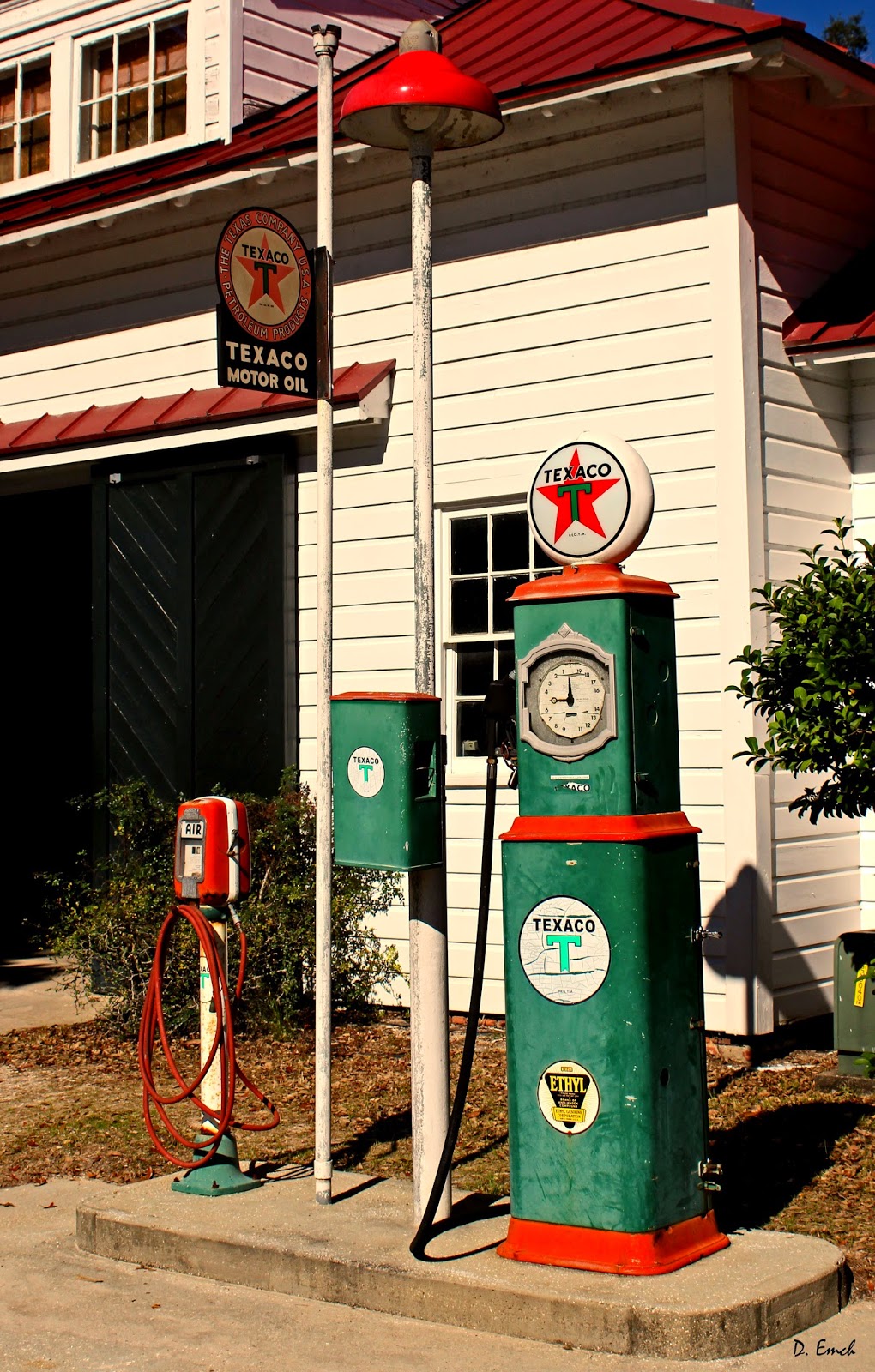
There are many relics scattered about the island from the ensuing Carnegie era - in fact there is still a bit of land owned by the Carnegie descendants. The Greyfield Inn is one of those, and is the island's only business. Here are some old gas pumps beside one of the out buildings.
Another of the descendants lives in the house below and owns GOGO Jewelery, a well known artistic brand of adornments.

Lucy, Andrew's wife, built "cottages" for their children. Below is one such place called "Plum Orchard."

David Meyer, pictured below, is a National Parks Service employee who has worked for many years on the Blue Ridge Parkway and on the mall in Washington DC. He guided the park's van tour of the island that runs five days a week.

Helping us at Plum Orchard was Minnesota native Jean. This park, like many in Georgia will give folks free room and board if they work on the property a certain number of hours each week. It really is a win-win situation.

This is Plum Orchard's entryway foyer. This mansion was built in 1898 for son George and his new bride Margaret Thaw.
George died young too - he kicked the bucket in 1921 and Margaret then married a Frenchman. There is a story that the Frenchman took took all of George's stuff including furniture, chandeliers, guns, books - about everything to New York and auctioned it off. This apparently irked mother-in-law Lucy quite a bit, because the Frenchman was promptly informed that he was no longer welcome here.
But, the story is contested by others who say Lucy herself auctioned off George and Margaret's belongings.

Here is a photo of the entryway before the items were disposed of. There are some scant furnishings about the house as you will see - I presume the Park Service has acquired them from others in the Carnegie family.

Just off the entryway is the formal dining room.

And immediately behind that is the kitchen. The park service spent over ten million dollars renovating the mansion, and this room absorbed its fair share of the assets. The floor was starting to collapse under the weight of that big iron stove, and had to be completely rebuilt.

Here is the "linen closet."

Also in this area there was an indicator with a bell on the wall. Each of the 30 rooms in the house had a rope hanging off the wall that you would pull to summon a servant. When you pulled the cord, the bell here rang and the arrow that corresponded to that cord popped up in the contraption below.

If you look closer you will notice I managed a "selfie" in that photo.
On the other side of the entryway lies a library and sporting room. I am not sure who bagged the trophies, but that is a big elk.

The bookshelves are very rare - they were made with American Chestnut wood before the chestnut blight wiped out all of the United States chestnut trees. It is thought a fungus brought in on Japanese trees was the cause.

Up the main staircase we head to the bedroom level.

All of the floors are wood, done in a square pattern with each small board hand nailed.

In the master bedroom you can see the pull-cord hanging from the wall.

Here is a bidet with four different water temperature controls behind a door with a crystal globe door knob. You can wash your backside in style at precisely controlled temperatures.

And what bathroom is complete without a Ben Franklin stove?

Here is a well appointed doll house thought to have been styled on a property in Pittsburgh.

And an old perambulator..

They got a bit smarter in later generations - there are fire hoses throughout the house.

Here is the circuit board for the electric. The house was run on DC current, and the wires were run through slats of wood for insulation

In the basement is a contraption that is new on me - a water tower powered elevator. A water tower stood outside the mansion, and the weight of the water that was pumped up into the top of the tower provide the power to operate this contraption.

Termite control - a piece of copper foil between the top of the masonry foundation and the wooden support beams.

Here is the old ice chest in the basement. There is one of the first ice making machines in this basement, but my photo didn't turn out. Supposedly the ice maker was built by a company what was the predecessor to modern day General Electric.

Prior to this, if you wanted ice in your house you had to have it shipped down from the north and keep it in sawdust.
Here is the hot water boiler - there is a coal bin close by. And of course coal has to be shipped in from the north as well.

Here is an old electric generator.

Back upstairs is a squash court with an observation balcony.

And a swimming pool.

The National Park Service has acquired over fifty percent of the island now. Most homes they acquire they bulldoze and in short order the forest returns.
There is another story that the developer of Hilton Head, Charles Fraser, drew up plans to buy large tracts of Cumberland and develop fenced in communities in a similar fashion to his previous development. Supposedly this irked the Cumberland's enough that they got a family friend to introduce a bill to congress that started the initial federal investment here.
One thing we have not seen anywhere before is a cactus that grows on oak trees. Here is a large branch, shown with the resurrection fern and this cactus growing out. There are numerous of these - has anyone seen such a thing before?

Today's "Faces in the Crowd" was taken on Cumberland.

And the parting shot was spotted in a tavern window in St. Marys.

EMAIL me if you
like, DONATE if you can,
Read
Today's Meditation if you have time, but whatever you do be sure to Have an Awesome Thursday !!
David


