

Welcome to Bath, Maine which was established in 1781 and has a current population of 8,500.

Along with a long and rich history of seafaring, I am told Bath had the distinction of being the smallest city by population in the United States - or at least so when it was incorporated in 1847. But before we delve into that we are heading out on the water to take in a few more of Maine's 65 lighthouses.

We are heading to the Maine Maritime Museum, which operates a sight seeing craft called the Pied Piper. No one was sure why the boat was named after a guy who played fife to lure rats into the sea.

They offer a couple of different cruises - this is the longest one that is expected to be on the water for about four hours.

We are along with Captain David Etnier and mate James Lasel. As we meander along they make observations on the geography, wildlife, history and architecture.
Bath lies about ten miles up the Kennebec River, which flows 170 miles from Moosehead Lake to the sea. The Kennebec River saw the first sea going vessel built in the United States in the early 1600's, and to this day large ocean going vessels are built along its shores. Thus, navigation along the river has been crucial for many generations.
This first lighthouse we see is called the Doubling Point Lighthouse, and marks a bend in the river just downstream of Bath.

This was an especially treacherous stretch, and had the additional protection of a bell tower for navigation in the fog.

Inside this pyramid, known as the Fiddler's Reach Fog Signal, was a system of weights, ropes and pulleys that operated a bell that hung on the extending arm. Lighthouse keepers would have to wind up the mechanism every twelve hours. The signal bell from this particular location now hangs at the entrance of the museum.

Immediately around the corner are the Doubling Point range lights. These lights were placed such that if the two lights, shining out the windows, were horizontally aligned so that the lights appeared to be one atop the other, the ship was proceeding through the area of the river that was safe.
A couple of miles downstream is another dangerous juncture - Squirrel Point.

This was also built in 1898 as part of a series of upgrades to local navigation. The boathouse on the property is unique.

Note that the front and the rear are perpendicular, but the roof mirrors the slope of the bank.
Next up is Perkins Island Lighthouse, also part of the 1898 improvements.

Note the clear pane of glass. There were actually two clear panes which, when aligned, indicated to an incoming ship that they were in the proper channel.
As we head out the river the angle of the sun turned the wake into a brilliant turquoise.

At the mouth of the river is Fort Popham.

Although earlier forts stood on this site and saw some action in earlier wars, this fort was built in the early 1860's as a civil war defense. It was also garrisoned during the Spanish American War and World War I, but never saw any action.
There are scores of small islands in this area - most of them privately owned. Many have a house or two - but none seem so dramatic as this one.

Sitting right at the mouth of the Kennebec, it seems as though it is huddled behind the trees for protection from the open ocean. The crew members remarked that it had not been built that long ago, but no one ever seems to visit it.
Two lighthouses mark the entrance to the river - the one closest to land is the the Pond Island Lighthouse, built in the 1850's and pictured at the beginning of this article. The other is the Seguin Island Lighthouse, circa 1795, which lies a few miles out to sea.

The sea's edge lighthouses all seem to be haunted on this stretch of coast. This particular one is haunted by the ghost of an early lighthouse keeper's wife who plays a melancholy tune on a piano, over and over.
You see, it seems that the lighthouse keeper brought a piano out with him so that she wouldn't be so bored with life on the little island. But the piano only came with one sheet of music. Before he could make arrangements to get more music for her winter set in. So she played the same tune over and over, day after day and week after week. It finally drove him mad and he chopped the piano up with an axe. When she objected he took the axe to her, then took his own life. There are many reports by folks who visit the island of a invisible piano that plays a tune every now and then - thought to be the ghost of the early keeper.
As we head across a stretch of bay we see a few whales surface.

The guides say we are lucky: it is uncommon for whales to be this close to the shore.
About a half our later we arrive at Cuckolds Island Lighthouse.

This is privately owned and operated as a bed and breakfast. I am told it is about $500 per night to stay here. It was built in the 1890's but later demolished, and the rebuilding was just completed last year.
That brings us to Ram Island Lighthouse.

There is a Ram Island in about every harbor - it turns out that farmers would leave the cantankerous rams on an island and only bring them in when they needed them for breeding.
This lighthouse marks the entrance to Boothbay, and it seems a lighthouse wasn't enough during storms. Many a captain claims that a ghostly woman in a long white dress waving a lantern from atop the rocks is all that saved them from wrecking.
Burnt Island Lighthouse is another that is quite picturesque. Built in 1821 it is Maine's 2nd oldest existing lighthouse.

And finally the Hendricks Head Lighthouse.

A fascinating event happened here back in 1871. An incoming ship crashed on the shoals, but the seas were too rough for the lighthouse keeper and his wife to do anything about. Later a mattress washed ashore. They heard strange sounds coming from the mattress, and when they opened it up they found a box with a baby girl. The lighthouse keeper and his wife ultimately raised the girl as their own.
However, on many a foggy or moonlit night locals see a ghostly woman walking up and down the shore - frantically searching for something. They say it is the ghost of the mother who set her child adrift still trying to find her babe.

I loved the angle of the sun in that last photo - the shadow of the bell on the fog tower and the fog tower on the lighthouse are quite distinctive.
Nature provided channels galore through this area, so we head through a swing bridge in Boothbay and take back water channels all the way back to Bath.

Mile after mile of shacks, cottages, houses and mansions dot the shores of this area.

Around every turn is another set of little islands, another small town, another hidden passageway or channel - it is delightfully mysterious and very appealing to the eye.

Some of the houses hang out over the water on stilts.

This next one crosses a split in the rock. The guides claim the floor of that connecting breezeway is made of glass so guests can sit and watch the marine life.

In other areas there will be a mile or so of uninhabited land other than a solitary house or cabin.

The bird life is both plentiful and used to boats. We saw many bald eagles along the way.
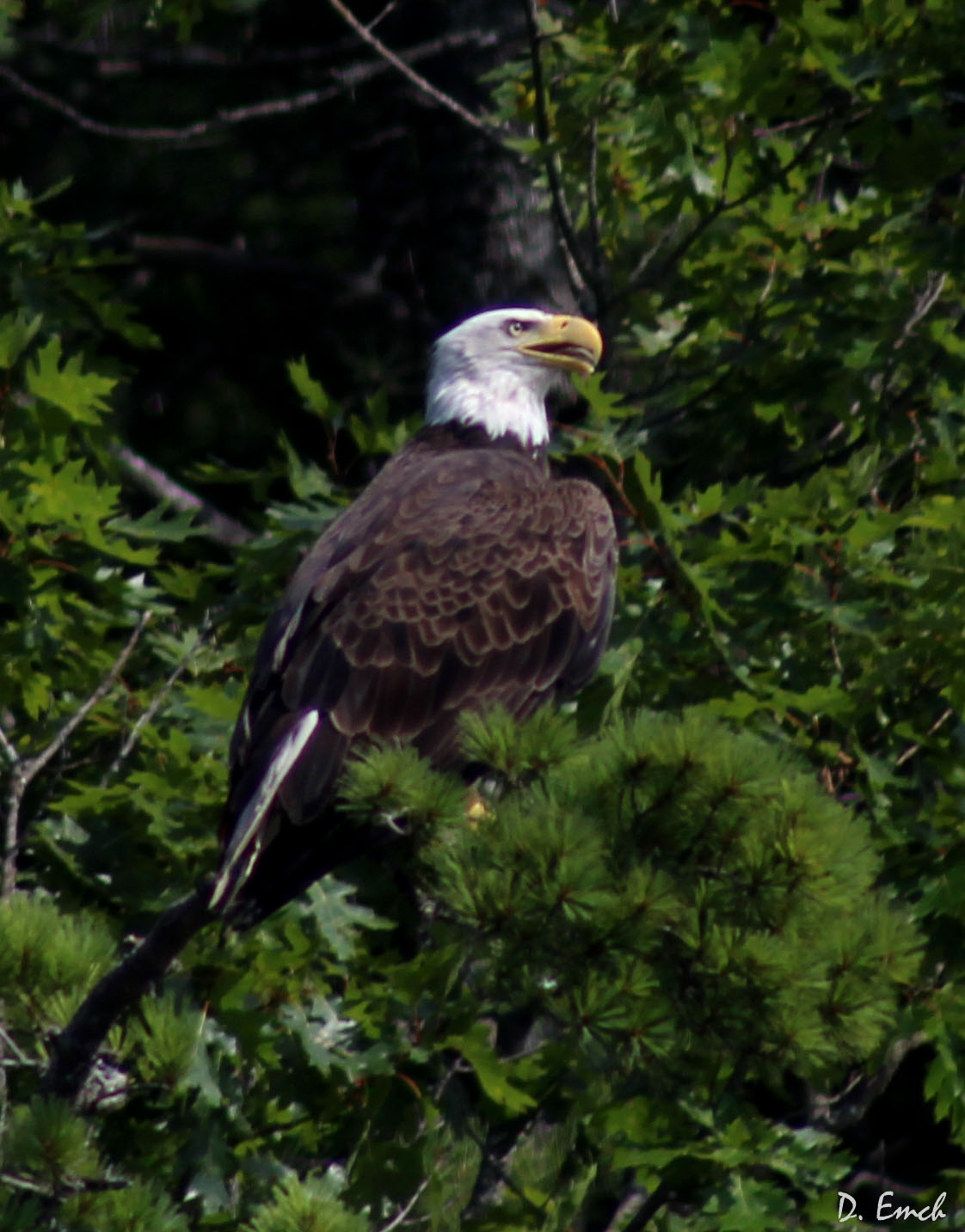
At least a dozen osprey came close by - many others were just out of the reach of my lens.

And of course the cormorants. They have to air dry their wings because they lack the natural oil that so many other water birds have.

As usual I could also have taken numerous pictures of dolphin fins and seal's noses. I did like this tree though.

That photo clearly illustrates the tenacity of life to me - a soft pine tree working over time to split apart sheer granite.
And that brings us to today's "Faces in the Crowd."

She was enjoying the ride immensely. And for today's parting shot - many houses fly flags - American flags, Maine Flags, Confederate Flags, POW-MIA flags, but this is a first for me.

The Martini Flag. Like the song says, it's five o'clock somewhere.
Have an awesome day !!
David
Click Here if you can contribute a few dollars to this effort, or email me at captureamerica1@gmail.com.


