Showing posts with label NC Ocracoke. Show all posts

Saturday, May 16, 2015

NC Portsmouth Island abandoned settlement


     In the last two days we have taken a look at Ocracoke NC.  But there is a big part of the Ocracoke story we have been missing.

     Ocracoke used to have a "sister city" named Portsmouth.  But Portsmouth was abandoned 44 years ago.  To get there we have to cross a few miles of water - across the inlet between Ocracoke Island and the northern end of Core Bank.

    Meet Captain Rudy Austin.


     When the last man living in Portsmouth took sick, Rudy'a parents allowed him to move in with them in Ocracoke for the last year of his life.  Rudy's wife Pat turned her ankle the other day, so on top of trying to keep on top of business and dealing with pesky reporter types, Rudy has to figure out if she needs to be taken off the island for x-rays.

     Rudy's son Donald also has a unique business here.
  

     On top of taking people duck hunting and on visits to the abandoned village of Portsmouth, he takes folks for ATV tours on the northern reaches of Core Bank.  You can visit his website by Clicking Here.

     On the way out to Portsmouth, we pass another abandoned structure.  This was the clubhouse for a fishing and duck hunting club for a while that is now defunct. 


     There was also a company out here that gathered guano to be sold for fertilizer on farms from these sandbars.  Guano is dried dung, and from centuries of birds visiting these small sandbars there was a foot or two of build up on them.  It only took a year or so to clear them and that company was gone as well.

     Speaking of birds they are not a dumb lot.  This is the pier that the National Park Service has built by Plymouth.  No sooner did they build it than the seagulls started using it to drop clams on.  The birds have figured out that if they drop a clam from high enough, the shell shatters and they can get a meal they otherwise wouldn't have.


     I was told that during the off winter months, the shells build up to where you are afraid that you will twist an ankle trying to walk down the pier.  During the season the pier is cleaned off daily.

     And so we approach Portsmouth.  The large building on the left is the old coast guard station that watched the entryway to Pamlico Sound.


    For centuries, the opening between Ocracoke Island and Portsmouth was the only shipping channel from Beaufort to Chesapeake - about two hundred miles.  But there was a problem - sand bars were still high enough that most ships couldn't make it through.

     So the town of Portsmouth would send out boats to offload enough cargo that the ships could clear the sandbars.  This was called "lightering,"  and besides the coast guard station here it really was the core of the local economy.


     Portsmouth was established in 1753, was the outer bank's larges community in the 1770's and began its decline in the 1860's when 685 was the population given on the census.

     A great thing that the National Park Service does is attract volunteers to act as interpreters in exchange for room and board.  We have seen this in a couple of the states also, and it seems to me it is a win-win for everyone. 

     Meet Ed Burgess.


     I didn't get a good photo of his wife Rene, but the two make a great team.  Their favorite thing to do is take an occasional excursion over to Beaufort and get an ice cream.  There aren't any provisions in Portsmouth besides what you bring, and no source of well water.  But the two of them love their half a year each year together here in this remote corner of the earth.  

    After arriving on the pier, a road leads back to the village.


     The beach here runs 57 miles all the way to Cape Lookout, and villagers used to drive their cars down the beach on Sundays to meet with the coast guard fellows down there.


     The National Park Service took this property over before the last residents left, with an agreement that they could live out their lives here.  The properties that are maintained are in surprisingly good shape, and several of them are furnished in part with things that were here and with replicas.

     A number of these houses are built on top of cedar logs, like the base of a primitive raft.  The "raft" is then tied to blocks of concrete that are poured deeper in the ground.  When the storms come, the houses float on the rising water, and then (hopefully) settle back into place after the storm passes.


     But there are 57 miles of abandoned bank here - land that used to host a number of small villages and camps.  Those not maintained are quickly reduced to rubble by the hostile marine environment.


     There are several cemeteries that dot the town - it seems every family had their own.


     The town church still stands but has some renovation work going on currently.  It got knocked off level by a hurricane a few years back, but seems to be back on an even keel now.


     As you can imagine, the residents here were a hardy lot - and fiercely independent.


     But life was not completely barren.  Photos show old cars, musical instruments and there was at least one piano and one organ.


     The post office held the general store, and was the center of social activity.   


     When the boat with the mail came, one of the local fellows would bring it up in a wheel barrow to the post-mistress.  After the coast guard left in 1937, the post-mistress was the only one on the island with a salaried job.  

     But that too passed as the post office closed here in 1959.  For a while this held South Carolina's smallest public school - two students.  And Portsmouth Island was the site of the first public road built by the state of North Carolina.

     There was one fellow who lived here back in the 1800's who didn't fare so well.


     The old photo of him isn't very good, but the story is that he so represented the image of James Wilkes Booth (assassin of Lincoln) that he was arrested and taken inland.  Only after townsfolk put up a big stink was he released.  But it is said the incident changed him - he returned to the island and started isolating.  After his death scores of empty bottles of Laudanum.  Back in those days, this was an oft prescribed remedy that was 10 percent opium.

    Shipwrecks were not an unusual here.  And when the crew got what they could, the ship was left to break apart and rot in the seas.  So the villagers would scavenge what they could.

    For instance, this cupboard came from a shipwreck.


     There is the story of a boot-legger that ran aground here back in the prohibition years.  The crew ran off as quick as they could, and it was a day until word got around and federal agents could come out and examine the wreck.

    Agents didn't find one barrel or bottle of booze in the ship, and so they turned their attention to the town and surrounding brush thickets, searching everywhere for the contraband.  They finally gave up and left empty handed.

    Turns out the good towns folk hid the booze down in the waste pits of their outhouses.  Gotta love folks ingenuity when it comes to squirreling away booze.


     Water was scarce, and kitchens were simple affairs.  If you didn't believe that fellow a few days ago that said he least favorite job was cleaning the cistern, here is what one looks like after it hasn't been cleaned for a while.


    Refrigeration is a huge problem in an area like this,  If you try to dig a root cellar you are going to have nothing but a pit of brackish water.  So the islanders used the principle that evaporating water absorbs heat.


     Each house has a little outdoor coop that held a large pan of water.  As the water evaporated it would cool, keeping things like milk and eggs good for an extra day or two.

     One of the biggest stories on these banks is the formation of the Coast Guard.  In the 1840's the Coast Guard expanded its responsibilities to aiding vessels in distress.  Prior to this many communities had volunteer groups that handled this, most of them ill equipped and with little or no training.

     The Coast Guard Station here was first commissioned in 1893, and saw much service in the few decades it operated.  


     Today it serves as a museum of the Coast Guard's implements and techniques during that time period.

     A quick segue before we look around inside - there is one story told about the coast guard station here as was told about the one just across the water in Ocracoke.


     Whenever a new guy would show up at either Coast Guard Station, all of the single women on both islands got all atwitter.  They would all try to figure out all the particulars on the fellows various assets and liabilities and if he was eligible and desirable, there was quite the effort to snare him into matrimony.

    It is said that the Coast Guard Commanders would warn the newcomers to the station about this situation, and there is an old quote about not taking off their shoes on the island because once the sand got between your toes you weren't going to be able to bring yourself to leave.   Of course, many of the men were willing participants, and a number of the island's families trace their roots back to fellows who stayed.  

     One of the large rowboats they used has been restored and is on display with its horse drawn carriage.


     The rescue folks would go out in the boat if they had to, but heading out into the surf is a very dangerous proposition.  They had a system they used for boats when they could get close to the boat on land.


     It involved a small cannon that was used to fire a projectile out to the ship.  


     The projectile was an iron torpedo of sorts that would be attached to a small diameter rope.


     The rope was woven around a sort of pegboard so that it wouldn't tangle while it was unraveling.


     Once the fellows on the ship had the small rope in hand, they pulled over a larger rope that was on big spools on another carriage.


     A harness was hooked to a pulley, and sailors could be ferried to the beach.  Below is an old photo of a shipwreck and this system in use.


     The island's last male resident was Henry Pigott.  Henry never had an education because it was against the law in North Carolina for blacks to attend school with whites, and since there was only one school house and the island's two white children took priority, he and his wife were denied any formal education.  Here is a photo of him as a dashing young fellow.


      Nevertheless, Henry was a good fisherman and provided well.  Here is the house he lived in up until he fell ill and had to move over to Ocracoke.


     There is another old photo of hi with a grand-daughter after a day of flounder fishing.


     And on his end table in the living room, a collection of his favorite things.  His bible, playing cards and dice and his liquor jug.


     There are a few gifts of gratitude that were given him by sailors who had been stranded here over the years.


     I spent most of the day with a fellow who came over with me from the Winston Salem area of North Carolina.  Regrettably, the piece of paper I was taking notes on was lost somewhere, so I don't have his name and phone numbers anymore.  If you know this fellow, please EMAIL me his info.


     He is a retired utility worker in his seventies, and after 40 some years of marriage his wife died.  His daughters help him get online and book excursions like this so he stays active.  He and I shared a number of quiet moments exploring, and hopefully his daughters read this.

     That brings us to today's "Faces in the Crowd" photo.  Remember that fellow that looked like James Booth?


     I don't think he liked photographers much.  And today's parting shot - showing the latest trend in evolution of tan lines - 


     On the personal front, steady as she goes.

Click Here if you can make a contribution to help me with this effort, Click Here to email me.

Make it a great day !!
David

Thursday, May 14, 2015

NC: Ocracoke Co-op fishery


     Welcome back to Ocracoke North Carolina.  This island runs east by north-east as it moves out to the tip of Cape Hatteras.


     The island itself is only accessible by boat or private small plane.  Ferries run southward to and from Cedar Island ($ 15) or northward to and from Hatteras (Free.)


     Ocracoke village itself occupies only a small part of the southern tip of the island.  The majority of the island is a federal nature preserve.  Southward beyond the village the sand bank runs out about another three miles - although at this point it is only a small spit of land a few yards wide.

     As we saw yesterday, life here centers on the harbor and a point of land just adjacent to the harbor where dozens of locals gather each evening to watch the sun set.


     There isn't that much developed land, and what is developed is  pretty well used up.  So most visitors choose to walk the town or rent another mode of transport.  Here are a few . .     


     Bicycles are big here, but golf carts are pretty common too.  


     Just outside of town the national park lands begin . . .


     . . . and about two miles up is a large campground sheltered just beneath the sea-side dunes.


     I always appreciate the ingenuity of folks that build their own campers.  I should take more photos of them. 

      But people who lived remote from society have a bit of ingenuity themselves.


     People are multidimensional, a remnant of times when you had to make do with what was already here.  Until recent times there was no ferry to run and get groceries or lumber or anything. 

     Things get used in ways you aren't used to seeing.  Here is the back enc of a pickup set up as a trailer.  I am not sure what they do with the front porch area.


     Besides the wild horses, there are only a few mammals out on these islands.  Raccoons, rabbits people and Nutria.


     Nutria are large South American critters that were brought here in the late 1800's.  They are not small, with adults averaging 15 - 20 lbs.  The idea was that they would be farmed for their furs.  Well, that proposition didn't work out so well, so they either got let go into the wild or they escaped during storms.  They look like a cross between a big beaver and a guinea pig, and are pretty destructive to wetlands.  I have been unable to photograph one - if I see one I will try to be quick on the trigger.

     Fishing has always been a big part of the economy here - if for nothing else for sustenance.  When hurricane Isabel slammed through here in 2003 and cut the bridges to Hatteras out, the people were fishing the next day.  It is that important to both the economy and the culture. 


    Not too long ago an Ocracoke boy named Morty Gaskill gained local notoriety when he opened a fishing business at age 13.

Photo from museum

     As they are everywhere, fishermen are fiercely independant folks, but they are also a crucial part of these small local economies.

photo from museum

    Ten years ago, Ocracoke fishermen got thrown into a panic.  It seems that the island's only fishery was put up for sale.  At the time it was run down enough that most figured it would just go out of business.  This would leave the local fishermen no way to get their catch to market.


     A grass roots effort came about, and today the fishery here is a community owned co-op.


     This was a big deal to these folks.  The fishermen were nervous about having to rely on a community owned market, but they were more worried about having nowhere to sell their wares.  

     We meet two of the people who make this work today - Pattie and Hardy Plyler.


     Hardy is a commercial fisherman who has found himself in the role of fishery manager.  Pattie is the face of the operation - she is behind the counter in the retail sales shop.  Without the retail sales the operation couldn't stay open, and many folks say they buy their seafood here just because Pattie is so personable.

     A brief note here - in these small towns I have to create a "circle" of people to interview.  The problem is that no one will say anything about what they do - they just want to express how much everyone else does.  So, in order to find out what a person's contributions have been you have to talk to other folks, and when you gradually make your way back around to who you started with you have your "circle."

     David graduated college at University of North Carolina with a bachelors back in 1972, but decided he loved the sea and came back to this coast to spend his life on the water.

A seagull stealing a scrap on the fishery dock

    Hardy talks about how many families the fishery had raised.  In these small coastal communities, there is a lot more to one of these fish houses than meets the eye.  For the fishermen, it is often their bank.  When they have to buy a motor for their boat or their nets wear out, they often go to the fishery for a loan against their future catches.

     The community gathers around the fish house too.  Locals always want to know who caught what - after all, its often what is for dinner.  Very often the meals served in homes and restaurants were swimming in nearby waters that very morning.

     But between increasing regulations, higher fuel prices and increases in unregulated imported seafood the industry was under tremendous pressure.  The area had already suffered the loss of about eighty percent of its fishermen over the last decade.  So, when a few locals came up with the idea of putting together a co-op that returned any profits to the fishermen, Pennie and Hardy jumped on board.

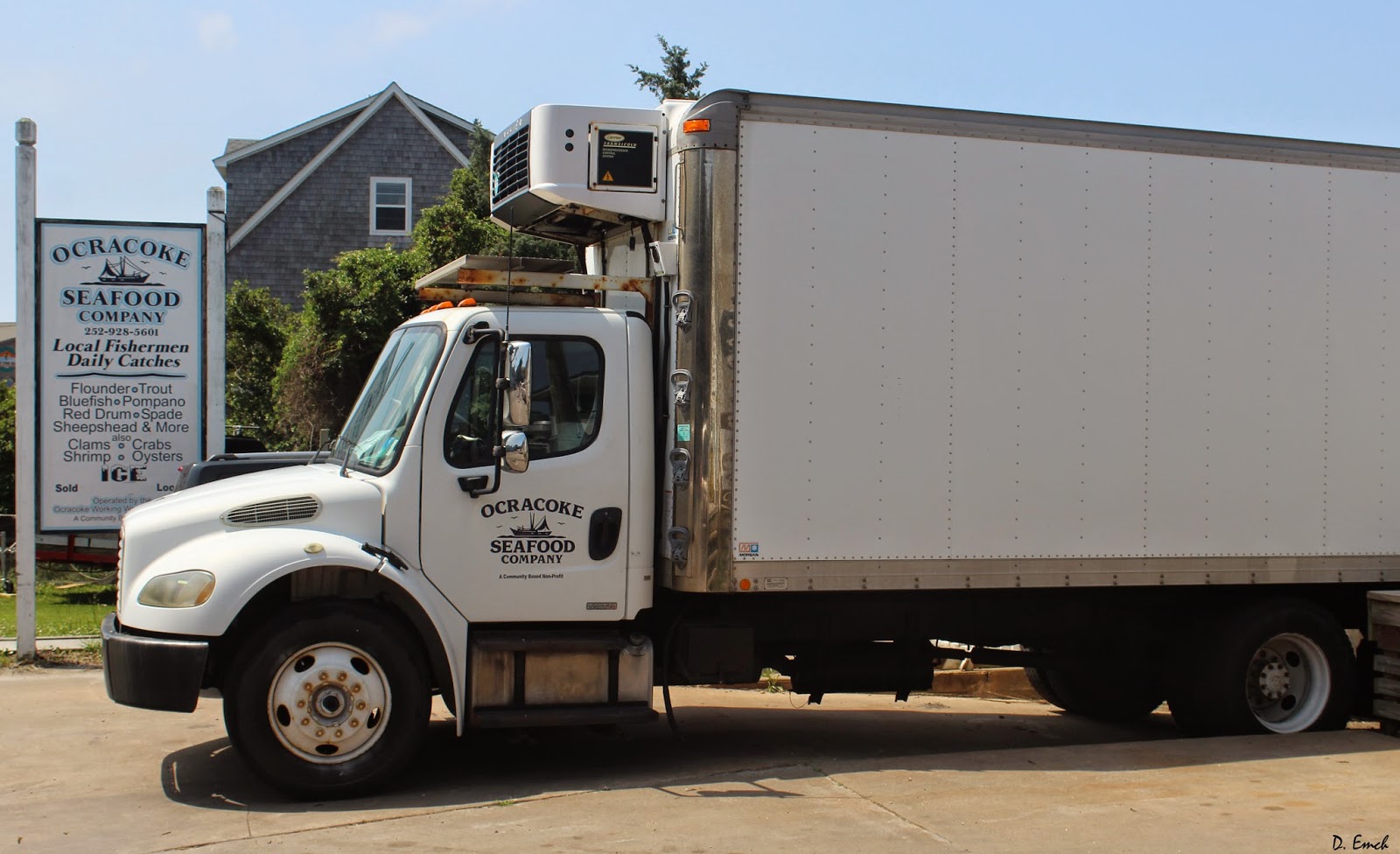
     The coop has been a huge local success, and it even has purchased a refrigerated truck that can carry each day's catch across on the ferry to markets inland.


     Fishermen that I talk to all loathe to discuss the regulations that keep putting more folks out of business but one thing in North Carolina is that all feel the state is suddenly against them.  There was an administration change a few years back that has brought folks into power who seem to be openly hostile to business.  

     Just last week this current North Carolina administration again made national headlines.  It seems they passed a law that said there will be no discussions held or efforts made that forecast a sea level rise exceeding eight inches over the next 85 years.  Everyone along the coast is much comforted that North Carolina has passed a law banning excessive sea level rise.  

     Well, there is an old saying that God doesn't call the qualified, he rather qualifies the ones he calls.  That seems to have been the case with the development of this fishery co-op.  Meet Robin Payne.


     Robin grew up in farming community well inland.  About twenty years ago she felt strongly drawn to move out here, which made no sense.  She had a degree in interior design and another in historical preservation, and neither skill is in demand here.  She gets terribly seasick, so she had no idea why she was supposed to move here.

     After several years living here the issue with the fishery came up, and she felt herself compelled to do something.  She got some books and read up on topics dealing with community resources, and decided that a 501c-3 foundation had to be set up.  She didn't know a thing about doing that, but researched and started moving forward with it.

     She says from there the thing snowballed in incredible ways.  No sooner would she fret about what she was supposed to do next or was stumped about how to get something done than the phone would ring, something would show up in the mail or someone would show up in town that had the precise piece of the puzzle that she needed.  She talked about finding that when she gets out of the way stuff comes through.

     She talks about things that far exceed the bounds of coincidence happening again and again - on a seemingly daily basis.  One example was when it was determined that they needed to put together local recipes to promote the idea that seafood was a crucial part of the local culture.  The next day, on a ferry, comes a nationally acclaimed lady who writes articles on local culinary techniques.  She did all the researched and everything emerged just as it was needed.

     Robin, who describes herself as being so shy as to almost be antisocial found herself with the strength to converse with all manner of groups - media, locals, teachers, fishermen, legislature - on and on it went.

     Of course, Robin wants to talk about everyone else's efforts, but she was the driving force behind making this happen.  As a result, thirty families still retain their traditions and are able to put food on their tables, clothe and educate their children and provide for themselves in the manner they are best equipped to.  Robin does make it clear though that she has found that life is at its best when she can serve others.

     The foundation and the fishery are just the beginning of the story.  There are numerous things Robin has been able to accomplish since.  There is an old historical house she was able to save and turn into a free museum.  Another wharf was saved and turned into a "Working Watermen's" museum.  The community has come forth with all manner or artifacts to serve as exhibits, and there are all kinds of historical and informative displays and literature that locals have put together to assist anyone who really wants to know about this area's culture and history.  There is a town square with parking spaces and public restroom facilities put together.  A public radio station for the island has been formed.  And there are new projects in the works - it will be fun when we come back six years from now to see where they have progressed to.


Working Fishermen's museum

    I want to go back to the topic of current trends in the North Carolina's state government. The ferry system is the life's blood here - without it almost all traffic would cease.  This holds true for several other communities out here on the coast as well.       

Ferry Docks in Ocracoke

     I have heard a common complaint from citizens back in Wilmington, on Cedar Island and here.  The state is letting the ferries go.


     Tourism is a huge feature in North Carolinas economy - it is estimated that last year visitors spent over 19 Billion dollars here in North Carolina.  This translates into a Billion in state tax revenue and 600 Million in local tax revenue, and a very large percentage of those dollars were spent out in these coastal areas.  

     But people are nervous.  Hull inspections, which are supposed to be done once every five years on these craft have been put off to the last minute.  Maintenance is falling behind.  And the local small businesses seem to feel that the state government is becoming hostile to them - even though they campaigned on the grounds that they were are the group that is friendly to business.   There are a lot of people out here that say they will be looking for big changes in the next election cycle.

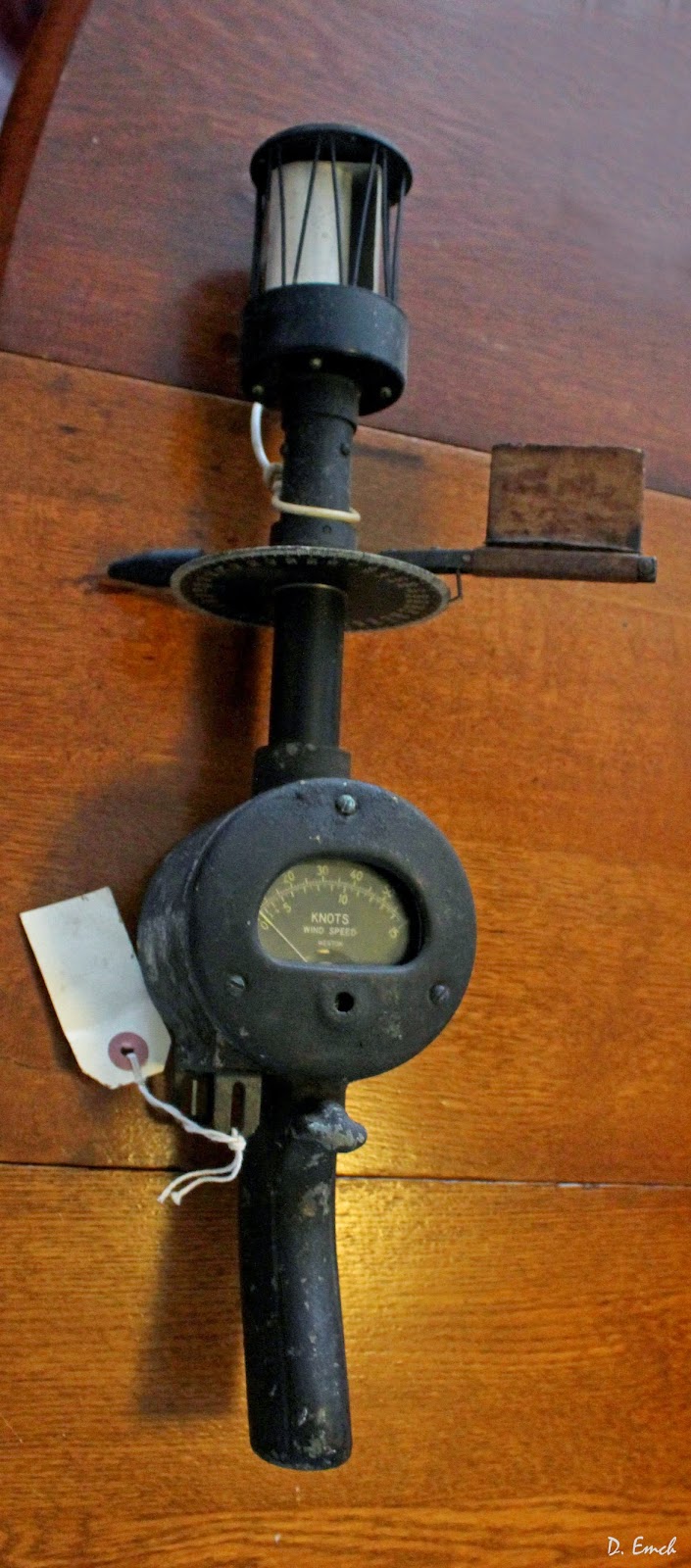
     About those museum pieces - here are a few pieces I found unique.  This first one is a ___________ - can you guess?


     It is an old "anemometer" - a device that can be held up by hand to measure the direction and intensity of the wind.

     Ever get sick of your small child escaping from their crib or play pen?  Well, here is the "Kiddie Coop."


     Certain months of the year the biting insects can get ferocious out here.  Thus, a screened in crib makes good sense.

     And for the coast guard and government workers who had to work in the soft mud marshes around the island?


     Marsh shoes - kind of like snow shoes but a bit different.  

         And here is quite a trophy.


    And every year the island has a contest - someone help me here - it is either a sailing contest or fishing contest.  Anyway, this is the Edward Teach trophy, featuring Blackbeard and the lighthouse.  Quite a handsome trophy if you ask me - it rivals any that we saw in the World Golf Hall of Fame.


     Before heading on up the coast, we are going to spend tomorrow in a sister city to Ocracoke that was abandoned just a few years ago.  Meanwhile, an obligatory shot of the beach:


     Today's "Faces in the Crowd" - you already saw it a bit ago, but I had to zoom in on this face.


     Either that moped seat is too small or island traffic has him frustrated - not sure which.

     Today's parting shot is a table top in a local restaurant.


     Now, I know a lot of you had to play one high-school sport or another.  I just cannot picture a high school football team being intimidated by the mantra "Fear The Pod."  Am I missing something here?

     And on personal notes, I found a great spot to park and sleep here.  


    The van has vent windows in the back, and when I can get them pointed toward the wind the breeze makes me sleep like a baby.  And the noise of surf doesn't hurt a bit either.

Click Here if you can contribute a few dollars to help me with this journey, Click Here to email me and Click Here to read today's reflection.

Have an awesome day !!
David