Showing posts with label ga st marys. Show all posts

Friday, January 9, 2015

St Marys GA Naval Submarine Base, Goodbread Inn, St. Marys Magazine, Oak Grove Cemetery


    There are a number of dynamics that swirl around St. Marys - some beneath the surface waiting to emerge, some finding their way to the surface and a few that are readily seen.  One of the things the town is known as is the gateway to Cumberland Island - an island just off the coast that is known as the jewel of Georgia's sea islands.


     A ferry runs to and from the island a couple of times a day except on Tuesdays and Wednesdays.  We are going to come back and visit this island in a week and a half, so for now we will just look at how it impacts St. Marys.

     It is estimated that upwards of 50,000 people a year pass through St. Marys and back while they visit Cumberland, a boon to the local economy.


     The town is situated on a spur off of the major roads, so it has retained its small town charm.  I always love the riot of color that a rack of kayaks brings to the scene.


     There is a good mix of shops, parking is ample and the look is exactly what you would expect.  


     A few of the yards even have orange trees heavy with fruit.  This is the last town before Florida, and there have bee a few mentions of orange groves further north that here, but this is the northernmost place we have seen them growing and the first place that has named a local landmark after them  (St. Marys Orange Hall Museum.) 


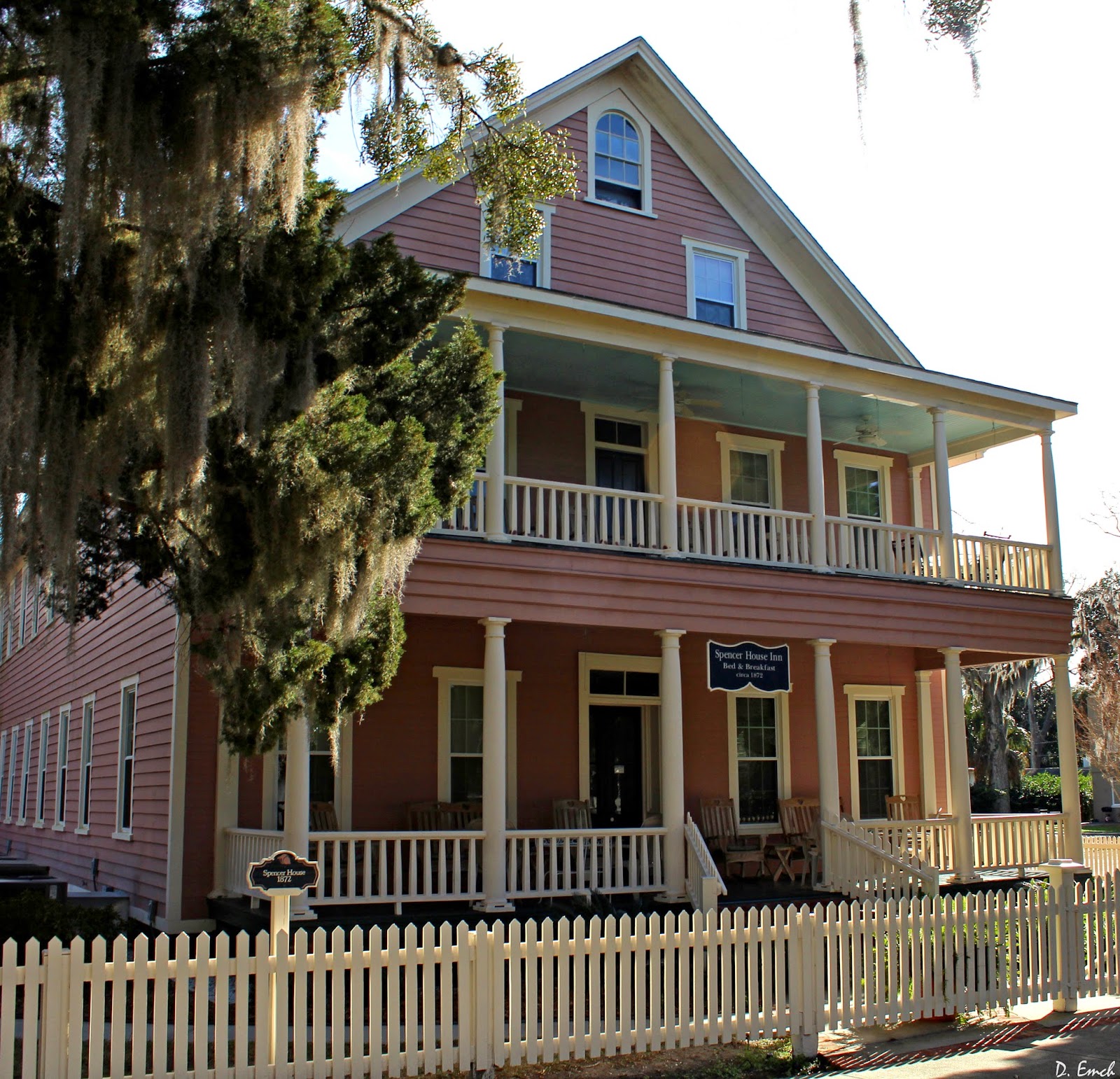
     Several bed and breakfasts compliment the old hotel downtown - this is the Goodbread House, built in 1870 and purchased by its namesake, Walton Goodbread, in 1901.


     I had the opportunity to trade my picket-fence painting skills for a few nights here - the first time I have stayed in a bed & breakfast.  It was a pleasant experience - the rooms large, there are numerous large sitting areas, kitchen and laundry facilities to use and the feeling you really are a guest.  And it has a really long picket fence !!


     Meet Mardja Gray, owner of The Goodbread House.  Mardja is a great cook and an attentive host.  She came here over a decade ago to meet a childhood friend for a couple of days.  The two of them decided they loved St. Marys that they would like to live here.   

Mardja Gray

          A month later, her house in Wilmington NC was sold, and she and her friend bought the inn.  One of her friend's contributions - a pirate that sat on her pier in Fort Lauderdale Fl.


     That friend is Barbara Ryan, who has a couple of decades experience as a publisher.  


     Not long after they arrived, Barbara got the St. Marys magazine going, and it now is widely distributed from Savannah to well into Florida.  Both ladies have been very active in St. Marys - in fact Barbara wrote, directed and produced one of the town's plays this last year.  

     She pours a lot of love, time and energy into the magazine, and it shows.  She enlisted me to proof-read a number of articles for the upcoming issue - my first gig as a proof reader.  


     There is a saying here that "You may leave St. Marys, but St. Marys will not leave you."  These two came and have not left yet - and the community is better for their contributions.  I am too - I also got a bit of work from them fixing up a bay window that the dog's claws had torn up a bit.  Here is a before shot - 


 . . and an after.  I would show the picket fence, but I have a bit more work to do on it when I return to write about Cumberland Island.  The work was timely - I just had several renewals come due on the website and the anti-virus software.  Thanks ladies !!


     One more picturesque old church - these old small town churches are so pretty I have trouble not photographing them.


     This one is a Catholic church, established in the 1840's.

     And, of course, we have to visit the cemetery.  Some of the neatest stories about a town are found through the cemeteries.


     One of the great stories of St. Marys is that of the Tragic Acadians.  France originally owned Acadia, but it was ceded to England in a treaty. The English renamed it Nova Scotia, 

     The population of Acadia - or newly minted Nova Scotia were hard working French settlers who had prospered in the area.  They also happened to be Catholic - a combination that the English couldn't stand.  So, the governor of Nova Scotia petitioned the King of England to send ships and 2,000 troops to help in what he referred to as a "Great and Noble Scheme."

     When the troops arrived, the Governor called all the Acadian men to the local church to "read a decree."  The church was surrounded by soldiers, and the Acadians were informed they were being deported.  The soldiers then went to all the farms, rounded up the women and children and burnt the farms.  This was the first ethnic cleansing that Europeans performed on themselves in the New World - they had previously held this tactic for the North American natives.


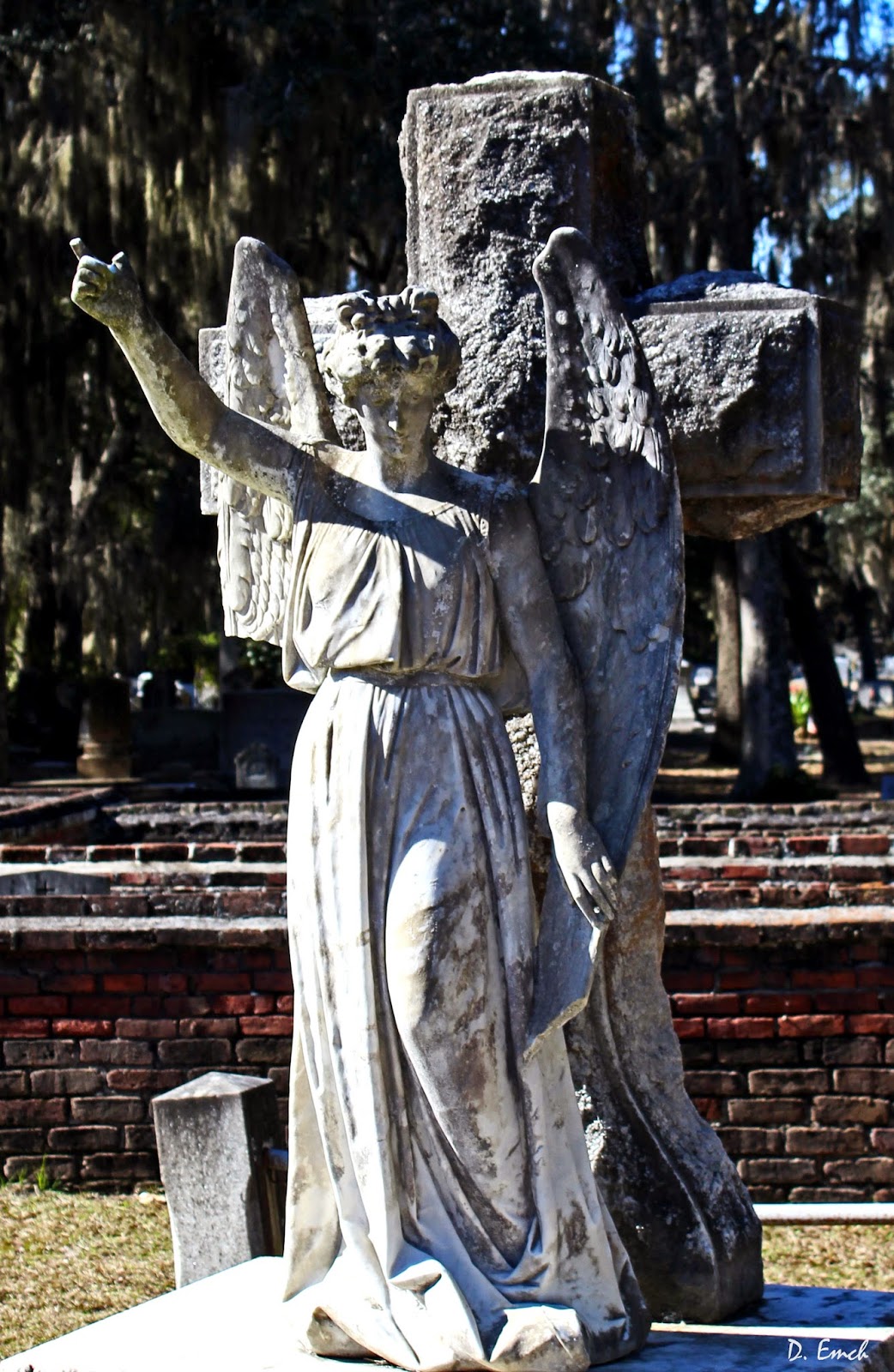
     They were held in a large fenced compound for weeks, and finally ships began arriving to carry them off.  They were then randomly dispersed wherever they could be gotten rid of.  Some of where their populations were disbursed remains a mystery, although modern scholars contend that the ones who were dropped off in Louisiana created the nucleus of what is now known as the Cajun culture.  The ones who ended up here had originally been dropped off in Haiti - and then had to flee there a few years later.  It is an interesting enough story that I will be watching for references to the Acadians from now on.  And they made enough of a contribution to society here that they are remembered in this graveyard.


     In 1954 the US Army began digging in a large wharf here to be used as an ammunition shipping terminal.  However, the facility was never really utilized.

    In 1975 Spain decided that they didn't want our nuclear submarines operating off of their turf anymore, and the USA needed another operations point on the Atlantic.


     So, one of Jimmy Carter's first acts as president was to sign legislation to move the base here, in his native state of Georgia.  In 1979 the first ballistic missile submarine was serviced here.


     Today, six ballistic and  two guided missile subs call this home.  These submarines each carry 24 missiles, each missile has eight independent bombs on it, and each bomb has about 30 times the explosive power of the bombs we dropped on Japan in WWII.  

     That means that each submarine can blow up 5,700 times what we blew up in Japan.  Six of these subs here, that means we can blow up 34,000 times more than Hiroshima - just from this one base.  I hope someone has a leash on our war-mongers. . .


     The submarine positioned at the entrance appears as it would emerging from the water.  Supposedly 2,000 of the base's 6,000 acres are set aside as protected wetlands.  There is a submarine museum in downtown St. Marys, but it was closed this last week.

     At the entryway I met Lieutenant V.M. Pacheco, who serves as Patrol Watch Commander for the Jacksonville Florida Sheriff's office.

V.M. Pacheco III

     Lieutenant Pacheco is the founder and the national commander of VEMA - Veteran Enforcers Motorcycle Association.


     The mission of VEMA is to raise awareness of the sacrifices that military, police and fireman have made for society.  "VEMA" is a loose Latin variation with the meaning "saw more."  They have organized and participated in events for The Fraternal Order of Police, Fallen Fireman's Foundation, Wounded Warrior Project and other groups including victim's advocate groups.  

     There are now 14 VEMA chapters, with groups as far away as Connecticut.

     Here is a new one on me.
     

     This fellow was working hard at dragging this sled with weights on it around a parking lot.  It must be an off-shoot of the new cross-fit craze.  

     Today, when I left St. Marys and hit the Florida State line, it started snowing - what's up with that?  I talked to a couple from northern Florida who is in their early twenties, and they said this is the first time they have seen snow in their life.  Kinda cool - pardon the pun

     And today's parting shot, seen hanging on a wall in Southern Georgia:


EMAIL me if you like, DONATE if you can, Read Today's Meditation if you have time, but whatever you do be sure to Have an awesome weekend !!

David

Monday, January 5, 2015

St Marys Georgia museum, railroad, theater, waterfront park


     Welcome to 2015 and welcome to St. Marys, GA, the southernmost coastal town in Georgia.  On New Years Day at 9 am it was 57 degrees here - I am sure some of you in the northern climes appreciate this reminder.  As of the 2010 census 17,121 people call St. Mary's their home.


     Steeped in history, St. Marys lies along the St. Mary's River, across which is Floridian territory.  The first recorded mention of this spot was by a Spaniard in 1564, but the Timucua Indians called this home for a couple of millennium before the arrival of the Spaniards.

     The town itself was chartered in 1787 when 20 families put up 38 pounds each and in return received 4 acres of land.


     In recent decades the town has experienced  revival of sorts.  Many folks have contributed to this re-birth, but one of the key contributors is former mayor and local businessman Jerry Brandon, pictured below with his wife Gaila.


     Jerry owns the local establishment Seagles, which has been passed owned by his family since 1931.  Overlooking the waterfront, this is an 18 room hotel with a restaurant and pub that are a beehive of local activity.


     In golf, it is a big deal for a guy to "shoot his age" - to be able to score a 70 on his 70th birthday.  Well, to celebrate his 70th birthday, Jerry swam 7 miles out the river to Fernandina Beach, then turned and swam back.

     During his tenure as mayor, Jerry was able to put together several projects that have redefined this town.  A major one is the waterfront park that stretches most of the length of the downtown area, including fountains, gazebos, numerous overlooks and swings, an outdoor theater, several community docks and fishing piers, public bathrooms, street lights and extensive walkways.


     Initially a grant from the state government for $900,000 was secured to beautify the waterfront.  But when the owners of the land on the waterfront were approached, that is just about what they wanted for the property.  Over a period of time Jerry was able to talk them down to $600,000, but this didn't leave much for improvements.


     Jerry got bids to put together a nice park which added up to $600,000.  Still short, he was able to find another $600,000 in a Georgia State discretionary fund.  Meanwhile, he was pursuing the local paper-mill to kick in money.


One of the community piers on the waterfront
 When he approached the city council with his plan, for whatever reason they turned it down.  Undeterred, Jerry started a rumor (he owns the local tavern) that the mayor of the neighboring town was going to buy the property and put in a private marina.


St. Marys Outdoor Theater

    Well, several city council members despised the neighboring mayor, so they approached Jerry about whether he thought he could still put together the water park.  And of course he could.


     So, back to the trustees of the paper-mill goes Jerry.  He tells them he will name the park after the owner of the mill if they kick in $600,000, and they agree !!  So now Jerry has a total of $2,100,000 to work with, and his expenses for the park are only $1,500,000.


     So, what does Jerry do?  He takes the extra money up the street a mile and builds a water-park.  The area includes a lazy river, a large community pool and this water playground.


     The water-park has since become fully self-sustaining - generating more than enough funds to pay for its own maintenance.  Well played Jerry !!

      Jerry is far from the only creative business mind in town.  Right when you enter town there is an old railroad depot, a remnant of the St. Marys Railroad from days long gone by.  The place was in ruins, flooded with a couple of feet of water and falling fast to vandals and decay.


     Meet Doug Vaught.  I was having trouble with my lens when I photographed him, so sorry for the blurry photo.  But Doug moves fast enough that even a good lens might have trouble staying in focus.


     Doug purchased the train station and renovated it into a local theater and small museum.  While I was here the local community was holding auditions for the play that will run in February.  The plays have become so wildly popular that they are sold out well in advance.  In many cases locals have waited until the last minute to purchase tickets, and find the show is so full that they cannot even wheedle themselves a spot in to watch the production.


     The community is deeply involved in the theater.  Various locals have written scripts including original music, casted and produced plays.  In fact, the play that will run in February was written by Gaila Brandon, who's husband Jerry did so much a mayor for the waterfront.  

     Pictured above, she is sitting at the left of the table below the stage watching various folks who are performing in an audition for her play.  

     There are some various old movie artifacts about the theater that Doug has collected, like this old projector.


     But his biggest collection sits outside the building.  Numerous railroad cars dot the tracks on the property.

      A while back, Doug acquired a few of these small self propelled railroad cars.


     When they started offering rides up the old tracks through the coastal hardwood forest a few miles and back, people were lined up around the building.  So Doug got hold of an engine and a few cars and started offering rides on full size cars.  This too went so well that they started using the local actors from the theater to act out various historical events at stages they have set up along the train's path.

Photo provided by Barbara Ryan and GM3 photography

      In another month, Doug has a genuine old steam locomotive on the way which will power a whole new year of this unique local attraction.

Photo provided by Barbara Ryan

     As if this weren't enough for Doug to have going, he has also founded another Coastal Georgia Film Alliance, designed to attract the film industry to the area. Georgia has recently passed some legislation that gives tax breaks to film makers.  Doug has capitalized on this and created this alliance that provides a unified voice for local economic development through budding relationships with the film industry.


     There is such a wide variety of beautiful spots along the Georgia coast that make great settings for films that Doug has been able to act as location manager for numerous recent films  


     One of the recent additions to Doug's vehicle collection is a specialty locations film vehicle he acquired from NASA.  I didn't have a chance to closely inspect the vehicle, but it looks neat.

     One of the locations that has been used for a couple of films sits right behind the train station.  It used to be the paper-mill - yes, the same one that helped fund the downtown waterfront project.


     A while back a Mexican company bought out the mill, and it wasn't long before it was run into the ground.  Literally.  For some reason, when the mill went bankrupt they knocked down all the buildings, leaving dozens of acres of rubble.


     This of course was a horrible blow to the town.  For a couple of generations the paper-mill had been the chief source of employment for the locals.  For a good while the huge mess attracted nothing but rodents and snakes.  But Doug has been able to utilize the area as a location for the filming of apocalyptic type scenes.  Think Zombie.


     Not far from where I grew up, the rubber and steel industries had abandoned huge plants.  They moved the industry to foreign countries, and left huge scars on the landscape.  Horrid pollution killed trees and wildlife for generations - in some areas nothing lives to this day.

     This site isn't quite as bad, but it is still a big mess.  The property is an ideal on, with deep water access right along the river.  There have been some fellows from a New York company wooing the local council, making promises about buying the property to use as a local barge port.  Maybe the locals can get Jerry Brandon to agree to put the gloves on for a few more rounds.  In spite of the mess, the place has huge potential and having someone who knows how to negotiate might spur a whole new layer of improvement to this town.


     This church dates back a good while - in fact it was established in 1808.  Back during the civil war, the Union Army stacked up a pile of wood against it, set it ablaze and left town.  


     As flames threatened to consume the church, local parishioners prayed for divine intervention.  The skies opened - a fierce thunderstorm rolled through and put out the fire.  

     The next house holds another bit of history.  After a duel in which he killed political rival Alexander Hamilton, Aaron Burr fled to this house seeking refuge from his friend Archibald Clark.  (Burr was the third vice-president of the United States, serving under Thomas Jefferson's administration.)   It has been said that if George Washington was the father of this country, then Aaron Burr was the crazy uncle. 


      Burr applied to local Cumberland Island for residency, but was denied.  Eventually the charges against him were dropped, but this ended his political career, and obviously, it ended Alexander Hamilton's as well.

     Another house of note is the Orange-Hall house museum.  This is considered a great example of Greek Revival architecture built in 1829.


     One of the exhibits that caught my eye was this sewing machine.  


     Built in 1851 by a company named Wheeler and Wilson, it is the oldest "automated" sewing machine I have seen.  Also, I love these old pianos.


     So many things seem to have been more artfully done in generations gone by - especially furniture and architecture.  Future generations may remember our times as the age of the box.

     Across the street is a museum showcasing items of a more recent genre'.  Georgia's Radio Broadcasting Hall of Fame is right here in St. Marys.


     You can peruse the history of radio broadcasting in the state, and there are numerous exhibits including old broadcasting equipment, radios and antique electronics components.


     Today's parting shot comes from the men's room in the remodeled train depot.


     So many of these funny signs I use as parting shots come from men's room walls.  Maybe I should start perusing the women's rooms - if anyone asks what I am doing I can just tell them I am trying to find out what I am missing . . . 


EMAIL me if you like, DONATE if you can, Read Today's Meditation if you have time, but whatever you do be sure to Have a great 2015 !!

David