

Wilmington NC, like Savannah GA, was built several miles up a river on a bluff. As we travel up the river, we pass a wharf for the large commercial ships. Although Wilmington is a significantly smaller port than Charleston and Savannah, there is still a decent amount of traffic comes in here.

Passing the commercial shipping docks, we arrive at a bridge across the river. This is where the tugboats and other vessels that do the grunt work on the river can be found.

For instance, you will find the large pilings used to build retaining walls being loaded onto barges here.

Nothing comes easy when you work in the marine environment. The ocean is unforgiving, and salt quickly corrodes most things it comes in contact with. There are a thousand ways to make a fatal error. And thus, the men who find a way to not only work in this environment but also flourish in it earn a special respect from me.

Jim Batey
Meet Jim Batey, businessman and father to four sons. You don't have to be around Jim long to realize that he has "been there, done that." He has had remarkable successes in life as well as a few deep troughs he has had to claw his way out of. And that combination has a way of molding a person that is fun to be around.
Jim has worked in all manner of businesses over the years, and over the last couple of decades one of his primary efforts was land clearing. When the economy tanked a few years back he was in up to his elbows. But in a well timed move, he was able to sell off his large land-clearing equipment to a company handling hurricane recovery efforts in Haiti.
One current project he has going is a tree farm. Before he got out of the land clearing business, he found out about a developer who had a big problem with a piece of land that had been a trash dump for a couple of generations. As the developer had already made his money on the project and was now facing heat from the local government about the piece with all the junk on it, Jim was able to basically swap his services cleaning up the trash for the land itself.
He now uses the land as a tree farm, growing Virginia oaks that he then transplants for landscaping firms. Here are just a few rows of the trees that are about at the size to be transplanted.

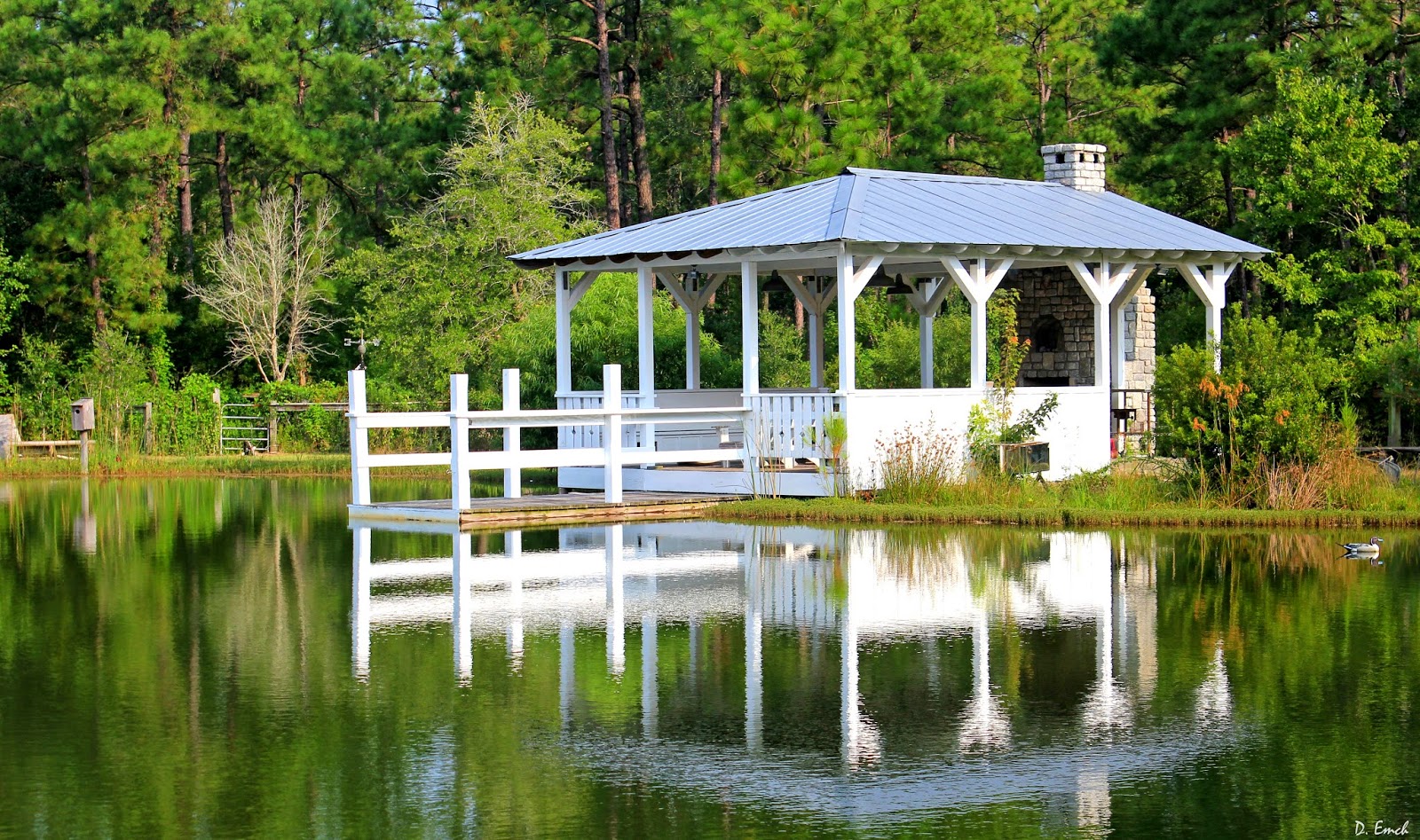
He and his sons then excavated a small lake in order to have water to irrigate the trees, and built a gazebo complete with a fireplace in it.
Jim seems comfortable in about any piece of equipment - here he is running a track hoe on the farm.

In the next photo, notice the wind mill in the background they installed to pump the water from the pond. It was built by Mennonites and works great, but they would like to increase the size of the fan (?) in order to gain more pumping capacity.

They built a pole barn on the property that they use for equipment storage and repair. But this isn't Jim's only current endeavor. Jim has carved out a neat little niche for himself and his sons in the marine business. You see, in a port town, there are ships of all shapes and sizes that do various jobs. Of course you have your big cargo ships and the tug boats that help them dock.
Often, when work needs done, barges with cranes are loaded up and moved to the site by those same tug boats.

Then there are the passenger boats that vary from recreational craft clear up to cruise ships.

But in between there are a lot of jobs that are too small to justify the expense of a big barge and too large to be done by passenger craft. Jim and his sons have assembled a small fleet of boats custom built to be versatile enough to fit these needs.

They have two landing-craft style boats that are just over 40 feet in length, plus another three that are a bit smaller. The other 40 footer is kept in the water here in Wilmington, ready to respond to local needs on a moment's notice. These craft are sea-worthy - in fact they have used them to transport several small dump trucks.

If your memory is sharp, you will recall that Jim is not the first Batey we have met. We met one of his four sons, Rusty, back on the river in Savannah.

Rusty Batey
Rusty helped us get all the great photos of the Savannah River. Rusty and his father are partners in this business that they named Zulu Marine Services. In Savannah, we were out on one of the 25 foot vessels, shown below.

Some of the jobs are a bit mundane, such as delivering port-a-potties out to job sites.

Some are a bit more exciting, like finding an old cannon and bringing it in to be restored.

Some are more difficult, like responding to oil spills and containing hurricane damage. The company has several thousand feet of containment booms to help keep large spills isolated in one spot until the pollution can be dealt with. There are many other projects these boats are used for - from serving as a diving or core-drilling platform to all manner of disaster response, underwater mapping and transport services.

But one of their recent projects is downright exciting. While offshore looking for fossils in water around 100 feet deep, they came across an old river bed that has been re-submerged since the last ice age. They found some unusual looking rock outcroppings, and brought a piece up. For a while, they didn't think that much of it and were on to other projects. But later, when the piece was accidentally broken open, they saw some unusual rock.

The rock, when fractured, creates very flat surfaces. They took it to the local community college, where a geologist informed them that it was a form of Chert. Back in the stone age, Chert was invaluable as the rock was easily worked to create high quality arrow and spear heads.
Because this is a whole new find, the Bateys were allowed to name the rock. They settled on the name Sea-Viculite, and if you click this link you can go to the site and read much more about it. (Below I am holding a piece they gave me to use as a whetstone - the stuff makes a great knife sharpening tool.)

Try to bear with me here because this is a cool thing. But I have to try to summarize details that have come from several extensive papers and studies to convey the crux of what makes this a great find.
The prevailing theory is that the ancestors of the American Indians crossed from Asia into Alaska, and there is much evidence to support this notion. But recent genetic studies have thrown a wrench into this idea. In some folks with "pure" American Indian lineage, mitochondrial DNA traits have been found that only occurred in European gene pools. (Mitochondrial DNA is only passed by a woman to her offspring.) So this indicates that at some point in the past women of European stock lived and gave birth on the North American continent - long before Columbus found the place.
Another issue that no one understands is that in certain of the most ancient North American Indian sites, there are arrow heads and spear heads that are carved in a very specific and exquisite style that has only been found one other place - ancient Europe. Further complicating the existing theory is the fact that a well preserved chert spear head of this type was found with the fossilized remains of a Mastadon, which carbon dating revealed was about 5,000 years older than when we thought the Indian's ancestors first arrived here. In fact this dates back to the last ice age. And during the last ice age, ocean water levels were much lower - low enough that this site that the Bateys have found was the banks of a fresh water river - the perfect circumstance for the stone to have been exploited for use in tool making.
Up until now, the only high quality chert in North America was found in Arkansas, so it was assumed that Indian tribes had traded this stone. Consequently assumptions about trade patterns and routes were based upon the idea that all tools and weapons of this type had to have originated from there.
Well, the composition testing that local universities have done on samples of this stone for the Bateys has revealed that the chemical make-up and physical characteristics of this rock match those ancient stone tools and weapons much more closely than the Arkansas deposit. So, what does this all mean?
Jim and Rusty are the cautious type; they are not ones to jump to conclusions. But I am more the reckless type, so I will call it as I see it. It looks to me like there was a European settlement here that dates to the last ice age and well pre-dates the migration of the North American settlers from Asia. It further looks like these earlier European migrants were then absorbed into the much larger gene pool of the later arriving Asian immigrants. How do we find more conclusive evidence for this?
Well, this spot that holds the Seaviculite needs excavated. Visual inspection gave the impression that there might be evidence of an earlier culture having mined the river banks, but without working the site no one can know for sure. The water it lies in is deep enough that finding the answers to this isn't going to happen with snorkels and fins - it will require heavy duty scuba gear and techniques. And currently, with all the money we feel we need to spend snooping on people and on weapons of destruction we have no money left to get the answers to questions like this.
So, for the time being the mystery will remain. But one day, if you spot a headline that says the old theory of American Indian migrations has been shattered, look for the names in the story. Odds are high you will find the name Batey - and probably more than once. And if that happens, we can remember that the discovery came about because of people that were curious enough about something unusual that they put forth the effort to find out more about it.

The whole thing has my curiosity piqued, so besides reading the literature I could find on this topic, I headed over to the Cape Fear Museum. They have some chert artifacts here, but none of them date back to the period we are discussing. You can bet I will have my eyes peeled in museums from now on.

And speaking of Bateys, meet Alex, Jim's third son. Alex just completed a degree in Marine Technology and passed his Captains License examination. And Jim's fourth son, Zach, just finished high school and is heading into this same program at the local college. It won't be long until he too is carrying the torch along with Jim, Rusty and Alex.

Jim and Alex took me out on the water here, and I will share more of the photos from that in tomorrow's article on the Cape Fear River. One of the highlights of the trip was their Labrador Retriever. It was the dog's first time out on a boat, and it took the whole ordeal with a mixture of enthusiasm and skepticism. While we were walking out the pier it spotted a large blue heron on the walk-way ahead, and rather than chasing it off it quickly ran back to hide behind Jim. It would be fun to watch the dog the first time it is in a boat and someone lands a big fish.

And today's parting shot - one of those super-stretch limos. They amaze me - it seems like one good bump and the thing should break in half. Maybe along the journey we can find someone who makes them and figure out what holds them together.

Have an awesome Thursday !!
David
If you can contribute a
few dollars to help with this journey, please click Here. If you have no idea what this is about, Click Here and Here. Click here to email me, and if you want to read
today's meditation just click Here. Thanks for your interest and support !!


