

Welcome back to Portsmouth New Hampshire. This area has become well known for its talented arts and crafts folks, namely pottery. The abundance of clay in the area led to over 75 brick manufacturers early on, and pottery is a cousin of that industry. However the industry itself almost died out until this man, John Winant, became governor of New Hampshire in the 1930's.

Times were tough when John was governor - the great depression had the country in its grips. He was looking for something that could contribute to the state's industry. The League of New Hampshire Craftsmen was formed in 1932, and in 1933 he persuaded the state legislature to contribute financially to the group. In a time money was scarce, this was no small feat.
A federal program in 1935 also helped - monies for vocational training were also funneled into the program. The league established a center and began holding workshops and classes covering all manner of arts and crafts skills. The league still exists today, and is complimented by the New Hampshire Art Association, founded in 1940.
On display at the Portsmouth Historical Society are examples of pottery spanning 8 decades.

Pottery making, arguably the first skilled craft, was crucial to the development of social structures for mankind. Prior to its introduction, the only vessels for storage of fluids and food stuffs were animal organs. Pieces over 30,000 years old have been found in Czechoslovakia and over 20,000 years old in China. Around 15,000 years ago its saw worldwide usage.
It can be argued that pottery making led to metal processing. As pottery was heated metals with a low melting point would form, thus cuing man in on the existence of metal. And pottery itself was the only substance readily available that could withstand the temperatures necessary to melt metals.
Pottery itself refers to anything composed of clay that is hardened by heating with the exception of some construction materials and electronics components. Pottery is divided into three categories - earthenware, stoneware and porcelain.

The basic differences between the three categories involve the heat they were fired at and the composition of the clay used. Earthenware is fired at the lowest temperature, and was all that early potters were capable of making. It is much softer than stoneware or porcelain and will absorb water. Today we commonly see earthenware used as outdoor planters.
With the exception of the photo above, all of the pieces show in this article are stoneware. The quality of clay is much improved from the clays typically used for Earthenware. As sediment from the granite and feldspar moves further down streams from the mountains, it picks up more impurities. Iron is a common one - thus the red color of brick. So clay that has formed closer to the source is used for stoneware, and the temperature it needs to be fired at moves up over the 2,000 degree mark.
Porcelain, shown above, is the toughest of the common potteries. It comes from an even purer form of clay and is fired over 2,200 degrees. This is commonly called "China" because that is where it was first made.

The oldest pieces of pottery found are artistic in nature, a few figurines found in Czechoslovakia.

The earliest known place pottery was actually manufactured was in Japan around 13,000 years ago. A big development was the oven, which emerged in the mideast about 8,000 years ago. Advances are still being made with synthetic materials - for example the tiles used on the space shuttle were a modern form of ceramic.
Prominently featured at the Historical Society is the modern day stoneware made by Sliptrail Stonemakers.
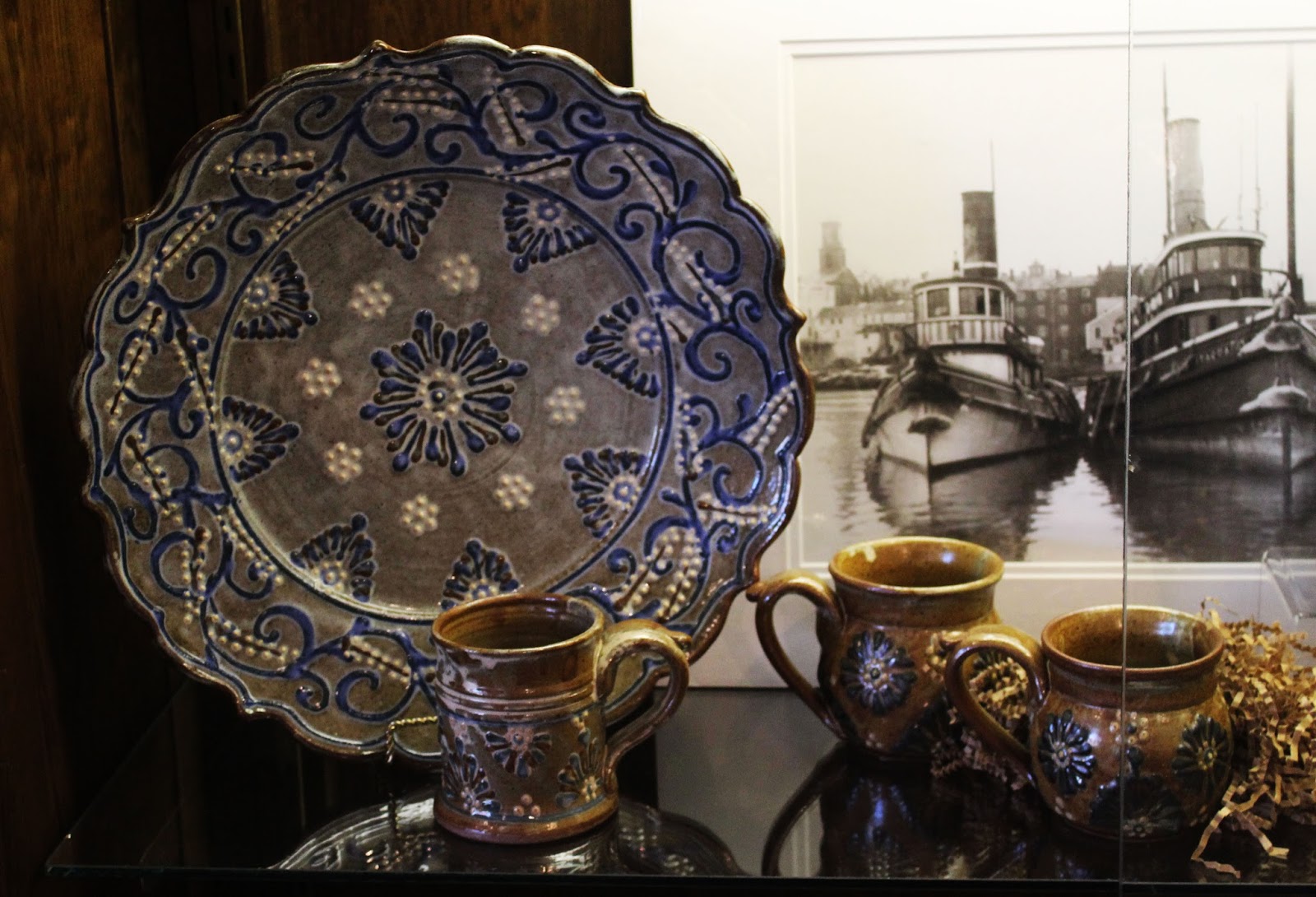
Slip trailing is a technique utilizing a liquefied porcelain clay to decorate the surface of pieces. The porcelain is about the consistency of yogurt, and various colors are achieved by the addition of various metal oxides. This allows a whole new dimension of creativity.
Local potters Steven Zoldak and Maureen Mills have just about perfected this art.

Steven and Maureen met at Arkansas State University back in the 1980's. After Maureen graduated with a degree in Chemistry she took a couple of classes on pottery at Arkansas State University. This is where Steven was pursuing a degree focusing on arts and textiles. They have worked together since.

Both teach pottery making at the adult level - Maureen at the New Hampshire Institute of Art and Steven at a local community college.

The two of them have their own unique styles, and work out of a shared space behind their home.

Over the years they have created many different styles of pottery.

photo courtesy of Maureen
Vases, mugs, plates and a large variety of other pieces can be seen on shelves in the various workshop and storage areas.

It all starts with this - a good clay. Today clays are blended to best suit the application they will be used for.

A big move forward was made when the pottery "wheel" came along. A spinning wheel allows for the efficient creation of symmetrical pieces.

Today Maureen is making a set of cups.

One of the attractions for people who buy these pieces is that no two are ever identical. Even if the shape is matched perfectly, small differences in the temperature of a particular spot in the kiln of the chemical composition of the components used make for differences in color.

Here Steven uses the slip trail technique to decorate some cups.

If they use the exact same materials when making a set, the pieces come out close to identical. But when previous customers come back and want an "identical" twin to a previously made piece, they have to let them know that there will always be subtle color differences.

After being formed and decorated, the piece is ready to be glazed. Glazing can accomplish three different things - coloration, decoration and waterproofing.
Glazes are made of highly refined clay products with various additives for coloration. For example the metal cobalt gives the distinctive blue color associated with China.

After the glaze is applied, the piece is pre-fired in a low temperature kiln. This sets the piece and the glazing for final firing.
Natural gas is the most common fuel used - it is clean burning and does not shift the coloration of the pieces like many other fuels. Steven built their primary kiln in one of the out-buildings.

When they are doing a production run, the oven, the oven is loaded and the pottery fired for several hours. In large operations the kilns are shaped like a tunnel and the pottery is slowly moved through on a conveyor.

Here are three pieces - the middle one is unfired, and the other two were made a day apart with the same clay and the same glaze. Minor differences in oven temperature make for a completely different hue on the two outside pieces.

Steven and Maureen make it clear that handmade custom pottery making is not an occupation you can "get rich" in. It is a lifestyle. Some days "the clay doesn't want to be worked" and other days the creative juices are flowing.
According to them a good pottery maker is one who can "get themselves out of the way" and allow their intuition to guide the process. Pieces all have a different "feel" - especially mugs and cups. There is a lot of room for creative expression in both form and decoration. Maureen's background in chemistry often helps when they are trying to achieve something new.
Also of note in Portsmouth is the African - American culture. A prominent memorial downtown remembers their travails and their contributions. It was built on a site were old graves were uncovered.

The earliest notation of slaves being brought here was in 1645. New Hampshire didn't have that many slaves, but they imported and smuggled them to many other states.
During the revolutionary war, local slaves overheard the talk about freedom. Several got together and drafted a petition to the legislature that called for all men to be free as slavery was "incompatible with justice, humanity and the rights of mankind." The petition was ignored, but somewhere around 1783 the state incorporated language that made all men free. It is unclear if the transition only applied to children born after that date or to all slaves.

The above picture is on display as part of an art project done by local school students. These are replications of the symbols used on the monument.
Also, a brief acknowledgment to the efforts of the Salvation Army here.

We will go into more detail about this group in a later article, but suffice it to say their efforts make a big difference in the community.

"Captain Dee" - Dee Coolidge, runs this particular branch. A full commercial kitchen turns out two meals a day for the homeless and needy.

They also provide meeting space for twelve step groups and other groups focusing on life improvement issues.

But first and foremost this is a church. Services are held here weekly.

They also reach out to veterans - I found this notice recruiting veterans for hospice work interesting.

And, believe it or not that's it for New Hampshire. There are less than 40 miles of coast here, and our next stop will be just inside the border of Massachusetts. The remainder of the coast is about evenly divided between state parks and residential areas. Here is a view of one of the beaches.

That brings us to today's "Faces in the Crowd." This is a young engineer from the Philippines that is here doing a co-op work project. She was out on the Gundalow ride taking photos.

And today's parting shot - a boat moored on the river.

I couldn't quite put the message behind the name together.
If you can contribute a few dollars to help me with this effort, please Click Here. You can email me at captureamerica1@gmail.com
Make it a great day !!
David


